
Research explained
Muscle memory: is it real, and how long does it last?
In the gym, muscle memory means that muscle you built before grows back fast after a break. It isn’t the skill kind of memory, like riding a bike. Small studies suggest it is real: people who stopped training regained lost muscle and strength quickly when they started again.
The short answer
+12.4%
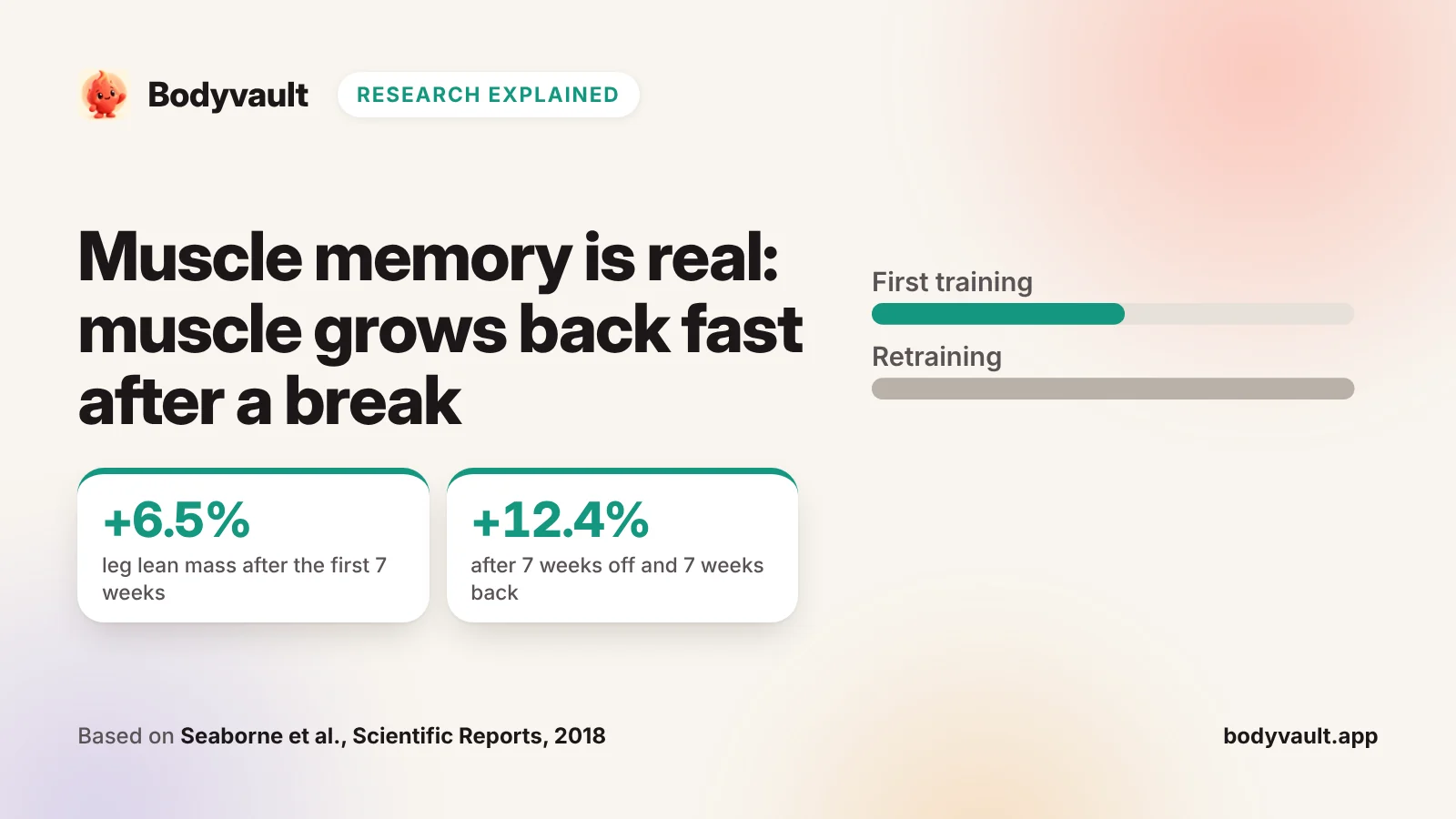
Leg lean mass after retraining, against +6.5% after the first 7 weeks (small study of men)
10weeks
Break that left people no worse off at the end of a 30-week trial
16weeks
Time off after which muscle cells still kept the extra nuclei that training added
3–6months
Breaks after which older adults’ muscle size was not yet clearly smaller
Strength of evidenceModerate
Several small trials show muscle coming back quickly after a break. How long the memory lasts, and how it works, is still debated.
Key findingIf you stop training, you will lose some muscle and strength. But much of it comes back quickly when you start again, so a break is not a reason to give up.
What is muscle memory?
People use the phrase in two ways. One is skill memory: your brain remembers how to do a movement, like riding a bike or swinging a racket. This page is about the other meaning, used in the gym.
Here, muscle memory means a muscle that has been trained before grows back faster than it grew the first time. The idea is that the muscle itself keeps some changes from earlier training, even after it shrinks.
Is muscle memory real?
Small studies say yes. The clearest test trained people, stopped them, and trained them again, while measuring their muscles at each step.
Leg lean mass through training, a break and retraining
After the break, lean mass had dropped 4.6% from its trained level, back close to the start. Seven weeks of retraining then took it 5.9% above where the first round of training had left it. The second round built more, even after allowing for the muscle kept during the break.
The study also looked at the DNA in the muscle. Small chemical tags sit on DNA and help turn genes off. Scientists call changes like these epigenetic. Training removed tags at thousands of spots, which can let muscle-building genes work harder.
Some genes kept their changes all through the break. Others reset during the break, then changed even more on retraining. The authors call this an epigenetic memory. It was one small study of men, though, with no group that kept training or stayed inactive.
How does muscle memory work?
Scientists have two main ideas, and they may both play a part.
Idea 1: extra nuclei
- Muscle cells are long and have many nuclei, the control centres that hold DNA
- Training adds more nuclei to each cell
- If they stay during a break, the muscle may regrow faster
Idea 2: tags on the DNA
- Training changes chemical tags that switch genes on or off
- Some changes last through a break
- The genes may then respond faster when training starts again
The extra nuclei idea is debated. In a 2024 trial, 12 men and women trained one arm for 10 weeks, then stopped for 16 weeks. The muscle fibres shrank, but the extra nuclei stayed. Fast-twitch fibres in the trained arm still had 33% more nuclei than in the untrained arm.
When both arms then trained for 10 weeks, the previously trained arm ended with bigger fast-twitch fibres. But it didn’t clearly grow faster during retraining. The authors say the benefit of the extra nuclei is still unclear.
A 2022 review pooled 147 human and animal studies. In rodents, the extra nuclei stayed after training stopped. In 4 human studies of 117 people, they did not. After breaks of 12 to 48 weeks, nuclei were back at or below their starting level. The authors think the DNA tags may matter more.
Does a break hurt your progress?
Not much, in the long run. A 2024 trial put 55 untrained adults into two groups by chance, so the groups could be fairly compared. They were 32 years old on average, and 45% were women. Forty-two finished.
Group with a break
- 10 weeks of training
- 10 weeks off
- 10 weeks of training again
- Lost strength and muscle during the break, then regained it fast
Group with no break
- 10 weeks of no training
- 20 weeks of training in a row
- Same total training: 20 weeks
Both groups trained twice a week. At the end, they had the same strength, muscle size and jump height. In the first 5 weeks back, the break group gained leg strength and muscle faster than the other group did at the same stage. The researchers say people need not worry much about an occasional break.
How long does it take to lose muscle?
It depends on how long you stop, and on your age. A 2013 review pooled 103 studies of people who stopped strength training. It looked at three things: strength below your maximum, your maximum force, and power (how fast you can produce force). All three fell, and the longer the break, the bigger the loss.
Losses were bigger in people over 65. Maximum force and power also fell more in people who were inactive before the study than in people who played sport for fun.
Change after stopping strength training
- Strength below your maximum−0.62 (−0.80 to −0.45)
- Maximum force−0.46 (−0.54 to −0.37)
- Maximum power−0.20 (−0.28 to −0.13)
What about muscle size? A 2022 review pooled 6 small studies of people aged 65 and over who had trained their thighs for 9 to 24 weeks. After 3–6 months off, their muscle was not yet clearly smaller. After 7–12 months off, it clearly was.
Thigh muscle size in older adults: training, then stopping
- Gain from training0.99 (0.63 to 1.36)
- Change after stopping (all)−0.83 (−1.30 to −0.36)
- After 3–6 months off−0.60 (−1.21 to 0.01)
- After 7–12 months off−1.11 (−1.75 to −0.47)
In the younger beginners above, 7 to 10 weeks off took away much of what they had gained. None of these studies tested breaks of a week or two. For a planned lighter week, see our explainer on the deload week.
How long does muscle memory last?
Nobody knows for sure. In the studies here, signs of it were still there after 7 to 16 weeks off. Breaks of years haven’t been tested in people. The 2022 review suggests the extra nuclei can be lost when muscles waste away, for example during bed rest, and with age. So muscle memory is probably not permanent, but it seems to outlast a normal break.
Claims and evidence
ClaimMuscle memory is just gym folklore.
EvidenceIn a small study, men gained 6.5% leg lean mass in their first 7 weeks. After a break, 7 weeks of retraining took them to 12.4% above the start.
ClaimIf you take a break, you start again from zero.
EvidenceIn a 30-week trial, a group that took a 10-week break caught up fully with a group that trained without one.
ClaimMuscle memory lasts forever.
EvidenceNo study has tested years. Extra nuclei stayed for 16 weeks in one trial, but a review of human studies found they were not kept once muscle shrank.
ClaimA long break costs nothing.
EvidenceStrength and power fell when people stopped, more the longer they stopped and more in people over 65. Older adults clearly lost muscle after 7–12 months off.
What this means for you
What this means for you
- Don’t panic about a break for a holiday, exams or a busy month. In the trials, lost muscle and strength came back within weeks.
- When you return, start a little lighter than before and build back up over a few sessions.
- The longer the break, the more you lose, so get back to training when you can.
- If you are over 65, try to keep breaks short. Older adults lost more when they stopped.
- If your break is due to illness, injury or pregnancy, follow your doctor’s or physiotherapist’s advice about when to start again.
What the research can’t tell you yet
- Small studies. The key trials had 7, 12 and 42 people who finished.
- Mostly beginners. Almost everyone studied was new to lifting. Experienced lifters may respond differently.
- Long breaks. Breaks lasted 7 to 16 weeks in young people and up to a year in older adults. Nobody has tested years.
- How it works. Scientists still disagree about whether the extra nuclei stay, and how much the DNA tags matter.
How Bodyvault uses this research
If 7 days pass without a workout, Coach suggests a short full-body session to get going again. It holds this nudge back while you report being unwell. The strength trend on the Train tab shows your estimated one-rep max for your main lifts. You can watch it come back after a break.
Share or cite this explainer
Bodyvault (2026). Muscle memory: is it real, and how long does it last? https://bodyvault.app/blog/muscle-memory
The charts on this page may be reused with a link back to it. The underlying data belong to the studies cited below.
Questions
Is muscle memory real?
Yes, in the sense that muscle grows back fast after a break. In small trials, people who had trained before regained muscle and strength quickly. How it works is still being studied.
How long does muscle memory last?
Nobody knows for sure. Signs of it were still there after 7 to 16 weeks off in studies. Breaks of years haven’t been tested in people.
How long does muscle memory take to come back?
Weeks, not months, in the studies. In a 30-week trial, gains came back fastest in the first 5 weeks of training again. In another study, men were past their old level after 7 weeks.
Can you lose muscle memory? Is it permanent?
It may fade. A review of human studies found the extra nuclei gained with training were not kept once muscle shrank. One later trial found they stayed for at least 16 weeks.
How long does it take to lose muscle?
It depends on the break and your age. In older adults, muscle size was not clearly smaller after 3–6 months off, but it was after 7–12 months. Strength faded more in people over 65.
Sources
- Seaborne RA et al. (2018). Human skeletal muscle possesses an epigenetic memory of hypertrophy. Sci Rep 8(1):1898.
- Halonen EJ, Gabriel I, Kelahaara MM, Ahtiainen JP, Hulmi JJ (2024). Does taking a break matter: adaptations in muscle strength and size between continuous and periodic resistance training. Scand J Med Sci Sports 34(10):e14739.
- Bosquet L et al. (2013). Effect of training cessation on muscular performance: a meta-analysis. Scand J Med Sci Sports 23(3):e140–e149.
- Cumming KT et al. (2024). Muscle memory in humans: evidence for myonuclear permanence and long-term transcriptional regulation after strength training. J Physiol 602(17):4171–4193.
- Rahmati M, McCarthy JJ, Malakoutinia F (2022). Myonuclear permanence in skeletal muscle memory: a systematic review and meta-analysis of human and animal studies. J Cachexia Sarcopenia Muscle 13(5):2276–2297.
- Grgic J (2022). Use it or lose it? A meta-analysis on the effects of resistance training cessation (detraining) on muscle size in older adults. Int J Environ Res Public Health 19(21):14048.
General information about fitness and nutrition, not medical advice. If you have a health condition, are pregnant or take medication, talk to your doctor before changing your diet or training.