
Research explained
Food order and blood sugar spikes: eat carbs last?
Eating your vegetables and protein before your carbs gave a smaller blood sugar spike in small trials, mostly in people with diabetes. It flattens the rise more than it removes it, and long-term benefits are not proven.
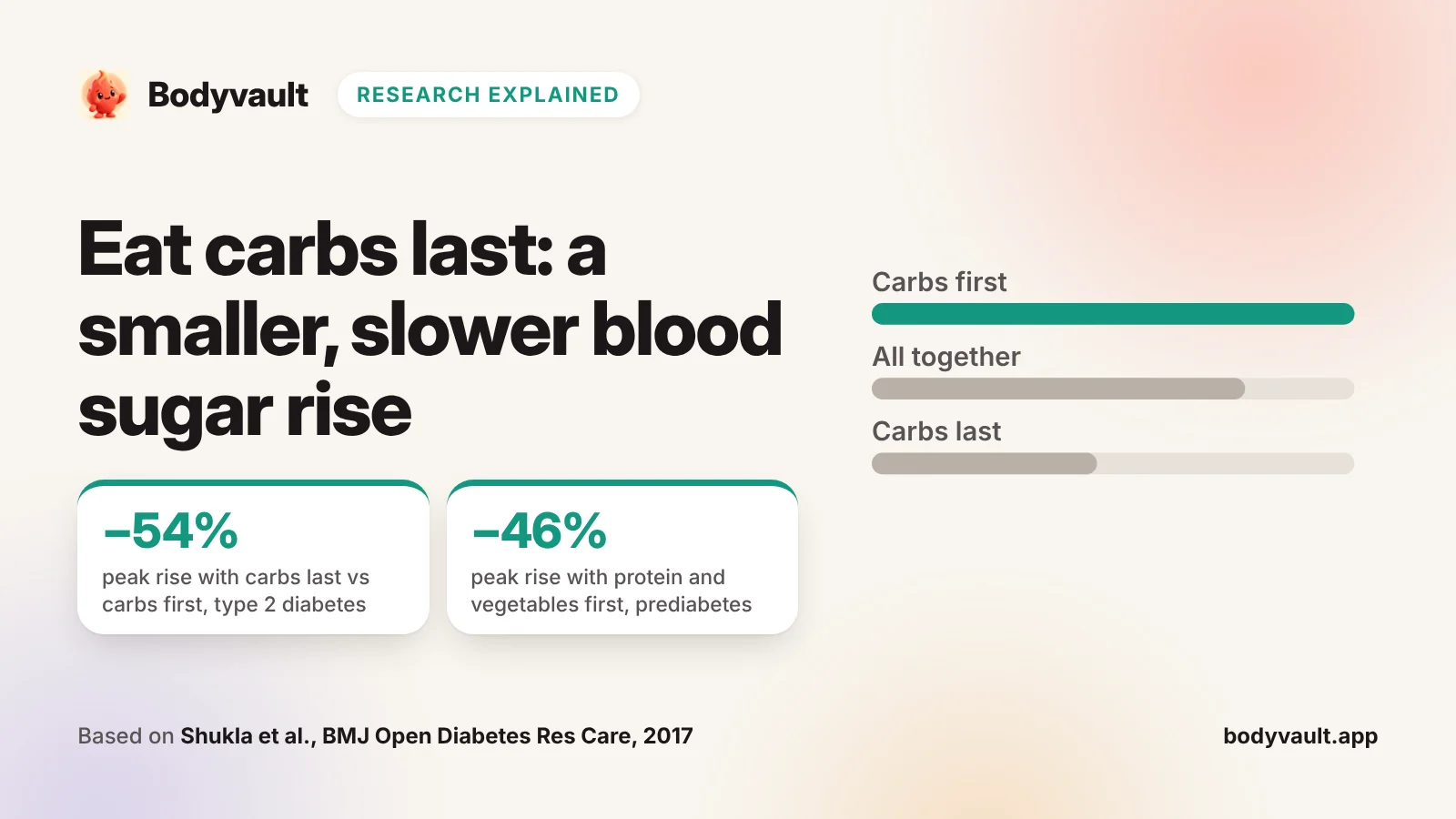
The short answer
−54%
Smaller peak rise in blood sugar when 16 adults with type 2 diabetes ate their bread last instead of first
−46%
Smaller peak rise when 15 adults with prediabetes ate protein and vegetables first
18
Trials in a 2026 review of eating vegetables first. Blood sugar was lower in the first hour, but the evidence is weak
−0.21 points
Change in HbA1c, a test of average blood sugar, in longer trials in type 2 diabetes: slight, or none
Strength of evidenceLimited
Many small trials agree that eating carbs last gives a smaller rise after one meal. But most were in people with diabetes or prediabetes, they were short, and reviews rate the certainty as low or very low.
Key findingEat the vegetables and protein in your meal first and the rice, roti or bread last. In small trials, this made the rise in blood sugar after a meal smaller and slower. It is an easy habit with little risk, but it hasn’t been shown to change long-term health.
What is a blood sugar spike?
When you eat carbohydrates (carbs), such as rice, roti, bread, fruit or sugar, your gut breaks them down into glucose. Glucose is a sugar that passes into your blood. Insulin, a hormone, then moves it into your cells. So blood sugar rises after a meal and then falls back.
“Spike” isn’t a medical term. Studies measure how far blood sugar rises above where it started, and for how long. The amount of carbs in a meal is the main driver of the rise. The type of carbs, what you eat with them and your own body matter too. For what is typical in healthy people, see normal blood sugar levels after eating.
Why does it matter? In people with diabetes, high blood sugar after meals adds to the high blood sugar that harms the body over the years. In people without diabetes, rises after meals are normal. No long trial has shown that making normal rises smaller improves health.
Why eating order could matter
Protein, fat and fibre slow down how fast your stomach empties. If they reach your stomach first, the carbs that follow get into your blood more slowly. Eating them first also releases gut hormones, such as GLP-1, that help your body release insulin. That is the likely reason, a 2026 review says. The total food stays the same. Only the order changes.
The first test: same meal, different order
In 2015, researchers in New York ran a small test with 11 adults who had type 2 diabetes and took metformin, a diabetes medicine. (Taken for years, metformin can lower vitamin B12: see vitamin B12 deficiency.) Each person ate the same meal twice, a week apart. One time they ate ciabatta bread and orange juice first, and chicken, salad and broccoli 15 minutes later. The other time they ate the chicken and vegetables first.
Blood sugar after the same meal, eaten in two orders
- Carbs first
- Carbs last
With the bread first, blood sugar reached about 199 mg/dL after an hour. With the bread last, it reached about 126 mg/dL. Over two hours, the rise was 73% smaller, and the rise in insulin was about half as big.
Carbs last, carbs first or all together?
Eating everything together landed in between. So in this test, it wasn’t only what was on the plate that mattered. When the carbs came mattered too.
Does food order help with prediabetes?
Prediabetes means blood sugar is higher than normal, but not high enough to be diabetes. In 2019, the same team tested 15 adults with prediabetes who took no diabetes medicine. Most were women. They ate the same meal three ways, in an order chosen by chance.
Both ways of eating the vegetables first cut the peak by more than 40%. With the bread first, blood sugar rose fast and then fell to its lowest point at three hours. One person had symptoms of low blood sugar after that meal.
What do reviews of all the studies say?
Single tests can mislead, so it helps to look at reviews that gather many studies. A 2026 review pooled 18 trials where people ate vegetables before their carbs. It included adults with and without health problems.
Blood sugar after eating vegetables first, compared with the same meal without them first
- 30 minutes after eating−22 mg/dL
- 60 minutes after eating−9 mg/dL
- 120 minutes after eating+4 mg/dL
The pattern matters. Eating vegetables first made blood sugar lower in the first hour. But at two hours, it was slightly higher. So the rise was flattened and spread out, not removed.
| Review | Who was studied | What it found | How sure |
|---|---|---|---|
| McKenzie et al., 2026 (6 trials) | 144 people with type 2 diabetes or diabetes in pregnancy | Eating carbs last generally gave smaller rises after meals | Low |
| Kampmann-Gongoll et al., 2026 (18 trials) | Adults with and without health problems | Lower blood sugar at 30 and 60 minutes, slightly higher at 2 hours | Very low |
| Kim et al., 2026 (6 studies) | 107 healthy young adults, mostly in Asia | Vegetables, fruit or protein first usually gave a smaller rise | Small, short studies |
| Okami et al., 2022 (8 trials) | 230 adults with type 2 diabetes | HbA1c changed slightly or not at all over 2 months to 2 years | Low |
Most readers don’t have diabetes. The 2026 review of healthy adults found six small studies with 107 people, whose average ages were 20 to 37. Most found a smaller rise when vegetables, fruit or protein came before rice or other carbs. But the studies lasted only 3 to 7 days.
The long-term picture is less exciting. HbA1c is a blood test that shows your average blood sugar over the past 2 to 3 months. A 2022 review looked at people with type 2 diabetes. Eating carbs later changed their HbA1c by only 0.21 points, which could be no change at all. The authors said this advice doesn’t add much to standard diet and exercise advice.
Does it work with Indian meals?
With an Indian thali, the idea is easy to try. Start with the sabzi, salad, dal or curd, and eat the rice or roti last. This is an idea based on the studies above, not a proven result for Indian meals.
One trial in the 2026 diabetes review did use everyday Indian meals. It was in pregnant women with diabetes that started in pregnancy. They ate fibre first, then protein such as dal, sambar, egg or fish, and rice, millet or chapati last. They also logged their meals in an app, which the other group didn’t do. And the review judged that the groups may not have been formed fairly. So the trial can’t show what food order alone did.
If you are pregnant, have diabetes or take medicine that lowers blood sugar, talk to your care team before you change how you eat.
Claims and evidence
ClaimEating vegetables first stops a blood sugar spike.
EvidenceIt makes the rise smaller and slower. In a 2026 review of 18 trials, blood sugar was lower at 30 and 60 minutes but slightly higher at 2 hours.
ClaimIt only works for people with diabetes.
EvidenceMost trials were in people with diabetes or prediabetes. Six small studies in healthy young adults found a similar effect, but they were short.
ClaimFood order fixes diabetes in the long run.
EvidenceIn longer trials in type 2 diabetes, HbA1c changed only slightly, if at all (0.21 points). Standard diet and exercise advice matter more.
ClaimWhat you eat matters, but the order doesn’t.
EvidenceIn one trial, the same meal gave a peak rise of 75 mg/dL with the bread first. It was 58 as a sandwich and 35 with the bread last.
What this means for you
What this means for you
- Start your main meals with the vegetables, salad, dal, paneer, eggs, fish or meat. Eat the rice, roti or bread last, and keep the total amount the same.
- You don’t need a long break between them. Trials used gaps of up to 15 minutes, and some used none.
- Pair it with a short, easy walk after the meal. Our explainer on walking after eating covers that research.
- If you use a CGM, compare several similar meals before you decide what works for you. One reading can mislead.
- If you have diabetes, are pregnant or take medicine that lowers blood sugar, follow your care team’s advice before changing how you eat.
What the research can’t tell you yet
- Small, short studies. The key trials had 11 to 16 people and tested single meals over 2 to 3 hours.
- Mostly people with diabetes or prediabetes. Studies in healthy adults were few and small, and mostly in young Asian adults.
- Long-term health. Longer trials found little change in HbA1c, and none tested heart disease or other health problems.
- Real life. Lab meals were weighed, set and timed. Everyday meals are messier.
- Weak certainty. The reviews rated the evidence as low or very low.
How Bodyvault uses this research
Meal Impact, part of Bodyvault Pro, gives a planned meal a low, medium or high band for its likely rise. In its what-if planner you can switch on “Veg, dal or protein first”. For meals with 25 g of carbs or more, it may suggest eating those first. If you wear a CGM, each logged meal shows its peak rise, time to peak and time back to baseline. Bodyvault can’t yet compare your own veg-first and carbs-first meals, because logged meals don’t record the order you ate in.
Share or cite this explainer
Bodyvault (2026). Food order and blood sugar spikes: eat carbs last? https://bodyvault.app/blog/food-order-blood-sugar
The charts on this page may be reused with a link back to it. The underlying data belong to the studies cited below.
Questions
What causes a blood sugar spike?
Carbs. Your gut turns rice, bread, fruit and sugar into glucose, which enters your blood. The amount of carbs matters most, and the type of carbs, what you eat with them and your own body change the rise too.
What is considered a blood sugar spike?
There is no official cut-off. Studies measure how far blood sugar rises above your level before the meal. To see what is typical in healthy people, read normal blood sugar levels after eating.
How long does a blood sugar spike last?
In these trials, in people with diabetes or prediabetes, blood sugar peaked about an hour after the meal began. It was falling by two to three hours. Eating vegetables first lowered the first hour but left blood sugar slightly higher at two hours.
How can I lower or avoid a blood sugar spike?
Eating vegetables and protein before carbs gave smaller rises in small trials, and the amount of carbs matters most. A short walk after eating may also help: see walking after eating. If you have diabetes, follow your care team’s advice.
Why is a blood sugar spike bad?
For people with diabetes, high blood sugar after meals adds to the high blood sugar that harms the body over the years. For people without diabetes, rises after meals are normal, and no long trial has shown that making them smaller improves health.
Sources
- Shukla AP et al. (2015). Food order has a significant impact on postprandial glucose and insulin levels. Diabetes Care 38(7):e98–e99.
- Shukla AP et al. (2017). Carbohydrate-last meal pattern lowers postprandial glucose and insulin excursions in type 2 diabetes. BMJ Open Diabetes Res Care 5(1):e000440.
- Shukla AP et al. (2019). The impact of food order on postprandial glycaemic excursions in prediabetes. Diabetes Obes Metab 21(2):377–381.
- McKenzie R et al. (2026). The impact of macronutrient ordering on postprandial glycaemic control in diabetes: a systematic review. Endocrinol Diabetes Metab 9(3):e70228.
- Kampmann-Gongoll K et al. (2026). Effect of eating vegetables before carbohydrates on glucose, insulin and glycemic control: a systematic review and meta-analysis of randomized controlled trials. Clin Nutr 66:106775.
- Kim J, Jang EH, Lee S (2026). Effects of meal sequence intervention on blood glucose response in healthy adults: a systematic review. Clin Nutr Res 15(1):55–63.
- Okami Y et al. (2022). Efficacy of a meal sequence in patients with type 2 diabetes: a systematic review and meta-analysis. BMJ Open Diabetes Res Care 10(1):e002534.
- Murugesan R et al. (2025). Impact of a structured food sequence and mobile health monitoring on gestational diabetes outcomes: a clinical trial. Front Nutr 12:1562240.
General information about fitness and nutrition, not medical advice. If you have a health condition, are pregnant or take medication, talk to your doctor before changing your diet or training.