
Research explained
Is working out right before bed bad for your sleep?
Working out right before bed is fine for most people. Two reviews of lab studies found that evening exercise doesn’t harm sleep. The exception is a very hard session that ends close to bedtime. In 14,689 people with fitness trackers, such sessions went with later and shorter sleep.
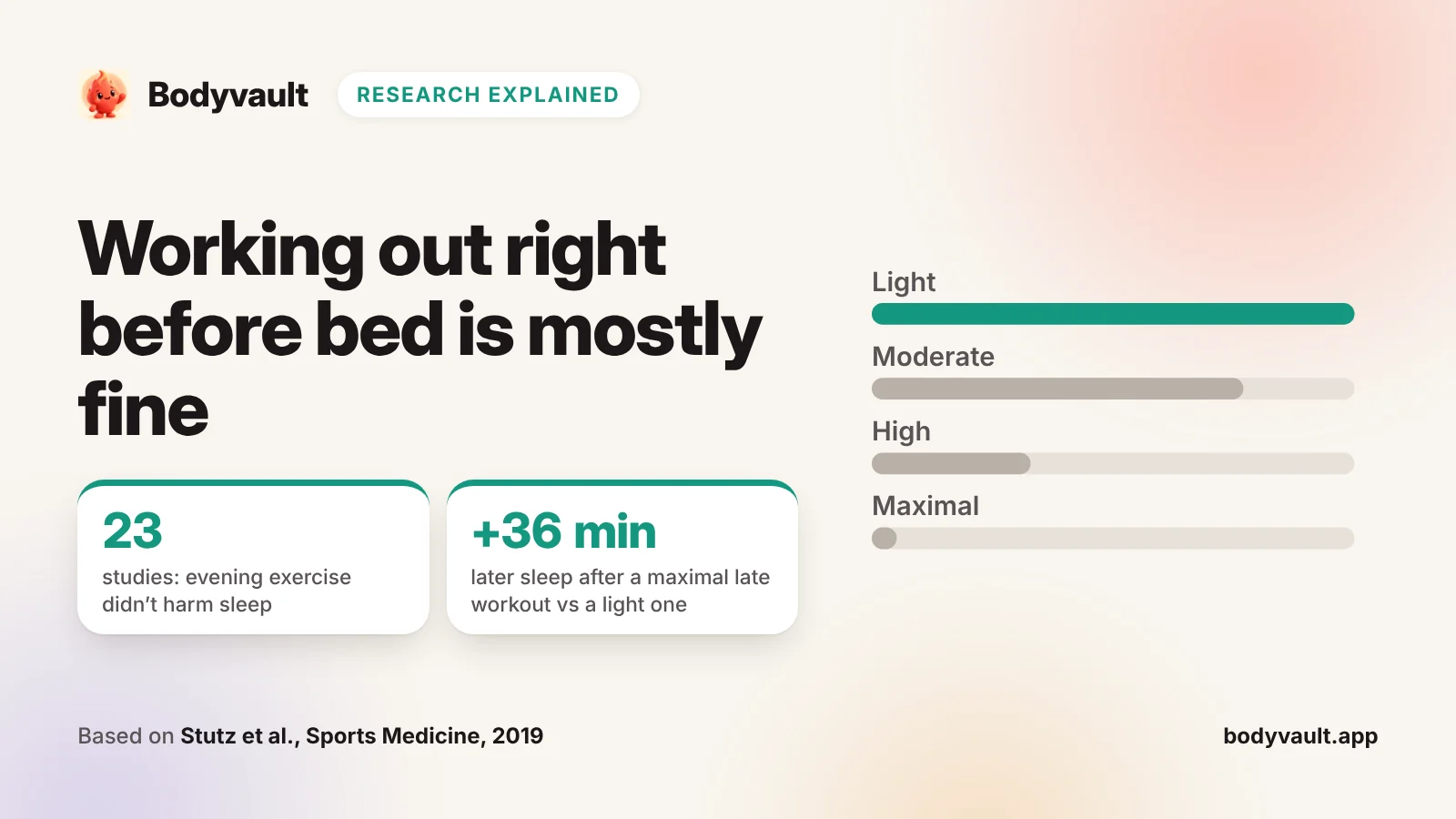
The short answer
23
Studies in a 2019 review. One evening workout didn’t harm sleep, and deep sleep rose slightly.
≤1h
Hard exercise ending this close to bed might make sleep worse, the review said
+36min
Later sleep after a maximal instead of a light workout ending 2 hours before usual sleep time
4h
Workouts ending at least this long before sleep showed no link with sleep changes
Strength of evidenceGood
Two reviews of lab studies agree that evening exercise doesn’t harm sleep in healthy adults. A big wearable study adds that very hard sessions near bedtime go with worse sleep, but it shows a link, not proof.
Key findingFor most people, an evening workout is fine. If you can, finish very hard sessions at least 4 hours before bed, and keep late sessions light.
Why a late workout might keep you up
For years, sleep advice said not to exercise in the evening. The worry was simple. Hard exercise raises your heart rate, body temperature and alertness. To fall asleep, your body needs to calm down again, as your heart rate and body temperature drop.
The harder the session, the longer this takes. So the real question is not only whether you work out in the evening, but how hard and how close to bed.
What 23 studies found about evening exercise
A 2019 review combined 23 studies of healthy adults. Each compared a night after one evening workout with a night without exercise. Overall, evening exercise didn’t harm sleep. In fact, deep sleep rose slightly.
The review found hints that harder sessions, or a warmer body at bedtime, went with more time awake. But these hints vanished when one study was left out, so they are weak. The authors’ only warning was about very hard (vigorous) exercise ending 1 hour or less before bed. It might delay sleep and shorten it.
Is high-intensity exercise before bed bad?
A 2021 review looked only at hard evening workouts. It combined 15 studies with 194 good sleepers aged 18 to 50. Workouts that ended between 30 minutes and 4 hours before bed caused no clear change in sleep. The only change was a small drop in REM sleep (2.34%). Regular hard training in the evening didn’t disrupt sleep either.
The authors concluded that hard exercise 2–4 hours before bed doesn’t disrupt sleep in healthy young and middle-aged adults.
Working out right before bed: what 4 million nights show
Lab studies are small: on average about 12 people each. A 2025 study used a year of data from 14,689 active people who wore a WHOOP wrist tracker. That is more than 4 million nights. It looked at when each workout ended, compared with the person’s usual sleep time, and how hard it was. This kind of study shows a link. It can’t prove that one thing causes the other.
Most workouts were light or moderate. The authors note that 82% of the lab studies in earlier reviews tested workouts in this range too. So the reviews mostly tested easier sessions. To see how hard a session is for you, try the heart rate zone calculator.
Sleep after a workout, by when it ended
- Light workout
- Maximal workout
Workouts that ended 4 or more hours before sleep showed no link with sleep changes. Light or moderate workouts ending more than about 2 hours before usual sleep time came with sleep much like nights without exercise. But the later and harder the workout, the later and shorter the sleep.
Take a maximal workout instead of a light one, ending 2 hours before usual sleep time. It went with falling asleep 36 minutes later and sleeping 22 minutes less. Resting heart rate in the night was 6.8% higher. HRV, the tiny changes in time between one heartbeat and the next, was 14.1% lower. The pattern was the same in women and men, and at all ages.
The authors also point out that caffeine, alcohol and bright gym lights around a late workout can affect sleep too. If you use a pre-workout drink, read our explainer on caffeine and sleep.
What helps: a warm shower or bath
A 2019 review combined 13 studies of warm showers and baths before bed. Water at 40–42.5 °C went with better sleep, as people rated it, and more of the time in bed spent asleep. Taken 1–2 hours before bed, as little as 10 minutes in warm water helped people fall asleep faster.
It may seem odd that warming up helps. The likely reason is that warm water sends more blood to your hands and feet. Afterwards, your body loses heat through them and your core temperature falls, which is part of falling asleep. The studies were few, so the best timing and length are still unclear.
Keep the water warm, not scalding. If you have a heart condition, are pregnant or feel faint in hot water, check with a doctor first.
Claims and evidence
ClaimExercising in the evening ruins your sleep.
EvidenceAcross 23 studies, one evening workout didn’t harm sleep, and deep sleep rose slightly.
ClaimAny workout within 3 hours of bed will keep you awake.
EvidenceLight or moderate workouts ending more than about 2 hours before usual sleep time came with normal sleep. Hard sessions 2–4 hours before bed didn’t disrupt good sleepers’ sleep.
ClaimHard training late at night has no cost.
EvidenceEnding 2 hours before usual sleep time, a maximal workout went with sleep starting 36 minutes later than after a light one. Sleep was also 22 minutes shorter.
ClaimA warm bath in the evening will keep you awake.
EvidenceWarm water 1–2 hours before bed went with falling asleep faster and better-rated sleep.
What this means for you
What this means for you
- Exercise at a time you can stick to. For most people, the evening is fine.
- If you can, plan very hard sessions, such as races, long hard runs or matches, at least 4 hours before bed.
- If you must train late, keep it light, like a brisk walk or an easy jog. Try to finish about 2 hours before bed.
- Give your body time to cool down. A warm shower or bath 1–2 hours before bed may help you fall asleep faster.
- Skip caffeine in the evening, including in pre-workout drinks. If you get chest pain, feel faint or very dizzy during exercise, stop and see a doctor.
What the research can’t tell you yet
- Small lab studies. Most tested a single workout in healthy adults.
- A link, not proof. The wearable study only observed people, so it can’t prove cause. Its people were active and mostly men, and two authors work for the tracker company.
- Weight training. The wearable study’s strain score may underrate weight training, so we know less about late lifting sessions.
- Warm baths. There were only a few studies, and we could read only the summary of the review.
How Bodyvault uses this research
Bodyvault marks a day as “late training” when a workout ends less than 3 hours before your bedtime. It looks only at the timing, not at how hard the workout was, and doesn’t treat it as bad. Once it has at least 5 late-training days and 5 others, “Your data shows” compares your sleep after them. It suggests training earlier only if your own data shows a clear cost.
Share or cite this explainer
Bodyvault (2026). Is working out right before bed bad for your sleep? https://bodyvault.app/blog/working-out-before-bed
The charts on this page may be reused with a link back to it. The underlying data belong to the studies cited below.
Questions
Is working out before bed bad?
Usually not. Two reviews of lab studies found that evening exercise didn’t harm sleep in healthy adults. Very hard sessions ending close to bedtime are the exception: they went with later, shorter sleep.
Is it good to exercise before bed?
It can be. In a 2019 review of 23 studies, one evening workout slightly increased deep sleep. Health guidelines recommend regular exercise for good sleep, so the best time is one you can stick to.
How long before bed should you stop working out?
For light or moderate workouts, about 2 hours seems enough. For very hard sessions, aim for at least 4 hours if you can. A 2019 review warned only about vigorous exercise ending within 1 hour of bed.
Does a warm shower before bed help you sleep?
It may. A 2019 review found that a warm shower or bath at 40–42.5 °C helped people fall asleep faster. Taking it 1–2 hours before bed, for as little as 10 minutes, was enough.
Can a pre-workout drink keep me awake?
It can, if it contains caffeine. Caffeine stays in your body for hours, so check the label. See our explainer on caffeine and sleep for cut-off times.
Sources
- Stutz J, Eiholzer R, Spengler CM (2019). Effects of evening exercise on sleep in healthy participants: a systematic review and meta-analysis. Sports Med 49(2):269–287.
- Haghayegh S et al. (2019). Before-bedtime passive body heating by warm shower or bath to improve sleep: a systematic review and meta-analysis. Sleep Med Rev 46:124–135.
- Frimpong E et al. (2021). The effects of evening high-intensity exercise on sleep in healthy adults: a systematic review and meta-analysis. Sleep Med Rev 60:101535.
- Leota J et al. (2025). Dose-response relationship between evening exercise and sleep. Nat Commun 16(1):3297.
General information about fitness and nutrition, not medical advice. If you have a health condition, are pregnant or take medication, talk to your doctor before changing your diet or training.