
Research explained
What does pre-workout do? Caffeine, beta-alanine and nitrate
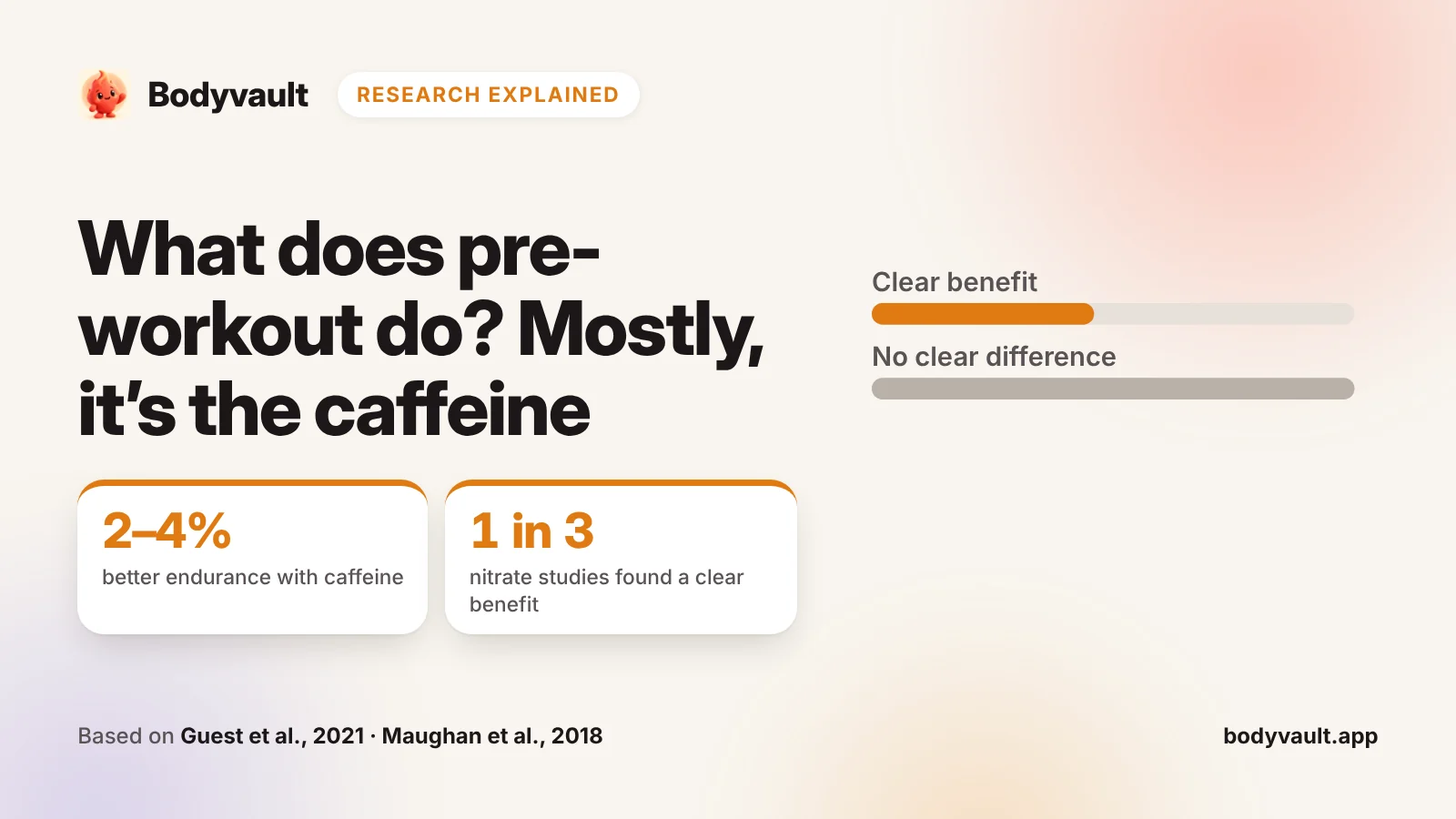
What does a pre-workout supplement do? Mostly, its caffeine gives you a small but reliable boost, of about 2–4% in endurance. Beta-alanine only helps after weeks of daily use, and nitrate from beetroot adds a very small boost.
The short answer
2–4%
Better endurance with caffeine at 3–6 mg per kg of body weight, across dozens of studies
60min
The most common time to take caffeine before exercise in studies
40–60%
Rise in muscle carnosine after 4 weeks of daily beta-alanine
1 in 3
Nitrate studies that found a clear benefit. None found that it made performance worse.
Strength of evidenceGood for caffeine
Caffeine has strong, consistent evidence. Beta-alanine and nitrate give smaller boosts, in certain kinds of exercise. Pre-workout mixes themselves are rarely tested.
Key findingMost of what a pre-workout does comes from its caffeine. Beta-alanine needs weeks of daily use, and its tingle is harmless. Nitrate gives a very small boost. Olympic experts say only a few supplements have good evidence, and any supplement can be contaminated.
What does a pre-workout supplement do?
A pre-workout is a powder or drink you take before training. Most contain caffeine, often mixed with several other ingredients. The amounts vary a lot. An expert review notes that caffeine can differ 8–9 times between pre-workout products.
Few studies test pre-workout mixes as they are sold. Some used a “blend” that didn’t say how much caffeine it had. So the best guide is the evidence for each ingredient.
| Ingredient | What it does | Dose used in research | Evidence |
|---|---|---|---|
| Caffeine | Makes you more alert and makes hard effort feel easier | 3–6 mg per kg of body weight, about 60 minutes before | Good: many studies |
| Beta-alanine | Helps muscles cope with the acid made during hard efforts | 4–6 g a day in small doses, for at least 2–4 weeks | Moderate: a small effect |
| Nitrate (beetroot) | Helps muscles use oxygen and energy more efficiently | 310–560 mg, 2–3 hours before | Moderate: a very small effect |
| Creatine | Helps short, hard efforts and adds to strength gains | 3–5 g a day, working over weeks | Good: see what creatine does |
| Sodium bicarbonate (baking soda) | Helps the blood cope with acid | 0.2–0.4 g per kg, 1–2.5 hours before | Good, but often upsets the stomach |
Caffeine before a workout
Caffeine is the best-tested ingredient. In 2021, an expert panel from the International Society of Sports Nutrition (ISSN) reviewed the research. Across dozens of studies, caffeine improved endurance by about 2–4% at 3–6 mg per kg of body weight. A review of 46 studies found time trials, which are races against the clock, were 2.3% faster on average. Gains in strength were smaller, about 2–7%.
The smallest dose that works may be as low as 2 mg per kg. Very high doses, such as 9 mg per kg, bring many side effects and don’t add benefit. People also respond differently. In one study, 13 of 20 cyclists improved with caffeine, and the other 7 got worse or stayed the same.
For a 70 kg adult, 3–6 mg per kg is 210–420 mg (our calculation). That’s about 2–5 cups of filter coffee. Our caffeine calculator shows how much will still be in your body at bedtime.
When should you take it? The most common timing in studies is 60 minutes before exercise. Caffeine reaches its highest level in your blood 30–120 minutes after you swallow it, and caffeine gum works faster. Your body clears half of it in about 4–6 hours, but this ranges from 1.5 to 10 hours. So caffeine in the afternoon can still affect your sleep. Read more in caffeine and sleep.
Beta-alanine: what it does, and why it makes you tingle
Beta-alanine is an amino acid, one of the building blocks of protein. Your muscles use it to make carnosine. Carnosine soaks up some of the acid that builds up in muscles during hard efforts.
Unlike caffeine, beta-alanine doesn’t work as one dose before training. It works by building up carnosine over weeks. The ISSN says 4–6 g a day, taken in doses of 2 g or less, raises muscle carnosine by 20–30% after 2 weeks. After 4 weeks, the rise is 40–60%.
Muscle carnosine with 4–6 g of beta-alanine a day
- Top of the range
- Bottom of the range
How much does it help? A 2017 review pooled 40 trials with 1,461 people. The overall benefit was small. It was clearest in hard efforts lasting from 30 seconds to 10 minutes, in tests of how long you can keep going rather than races. Being trained or untrained didn’t change the result. The ISSN says the clearest gains are in efforts of 1–4 minutes, and that more research is needed on strength.
How big are the effects of beta-alanine and nitrate?
- Beta-alanine, all tests0.18
- Beta-alanine, 0.5–10 min tests of how long you can last0.50
- Beta-alanine, 0.5–10 min races and time trials0.11
- Nitrate, all tests0.17
- Nitrate, very fit endurance athletes0.02
- Nitrate, studies of women only0.12
Now the tingle. It’s called paraesthesia, and it usually appears in the face, neck and backs of the hands. It is common when people take more than 800 mg at once, and bigger doses cause more of it. It goes away within 60–90 minutes. Experts think beta-alanine switches on nerve sensors that end in the skin.
There’s no evidence the tingle is harmful. Smaller split doses, such as 1.6 g, or slow-release products reduce it. Beta-alanine appears safe for healthy people at the doses used in research, but there are no safety data beyond a year of use.
Nitrate and beetroot juice
Nitrate is found in leafy green and root vegetables, such as spinach, rocket, celery and beetroot. Your body turns it into nitric oxide, which helps muscles work more efficiently. Beetroot juice is the usual supplement.
A 2020 review pooled 80 studies with 1,179 men and 156 women. Nitrate gave a very small boost, worth about 3%. That’s about 48 seconds in a 16.1 km cycling time trial. On their own, only about 1 in 3 studies found a clear benefit, and none found worse performance.
The boost was missing in very fit endurance athletes and in the 6 studies of women only. Women made up only about 1 in 10 of the people studied. Nitrate worked best at more than 5 mmol (about 310 mg), taken 2–3.5 hours before exercise. The IOC suggests 310–560 mg, 2–3 hours before. Antibacterial mouthwash may blunt the effect, because mouth bacteria help turn nitrate into its active form.
Is pre-workout safe?
Europe’s food safety agency (EFSA) has set safety levels for healthy adults. Caffeine raises no safety concerns up to 400 mg a day, spread out, or 200 mg at once. That includes taking it less than 2 hours before hard exercise. In pregnancy and breastfeeding, the level is 200 mg a day. And a single 100 mg can affect sleep in some people, especially near bedtime.
Research doses can go past these levels. For a 70 kg adult, 6 mg per kg is 420 mg at once (our calculation). Side effects of caffeine include a fast or pounding heartbeat, anxiety, headaches and poor sleep. They become more common as the dose goes up.
The other risk is what’s in the tub. In most countries, supplements are sold like foods, so makers don’t have to prove they are safe or that they work. In one large study, about 15% of more than 600 supplements contained steroid-like substances that weren’t on the label. If you compete in a drug-tested sport, a banned substance can cost you, even if you didn’t know it was there.
Claims and evidence
ClaimA pre-workout builds muscle.
EvidenceCaffeine gives a short-term boost on the day. The IOC lists creatine, not caffeine, as the supplement that adds to lean mass over weeks of training.
ClaimThe tingle shows that beta-alanine is working.
EvidenceThe tingle comes from nerve endings in the skin. Big single doses cause the most tingling, but they haven’t improved performance. The benefit builds over weeks of daily use.
ClaimMore caffeine means a better workout.
EvidenceDoses of 9 mg per kg or more didn’t add benefit. They brought more side effects, such as nausea, anxiety and poor sleep.
ClaimBeetroot juice works for everyone.
EvidenceAcross 80 studies, it gave no clear boost to very fit endurance athletes, and few studies included women.
What this means for you
What this means for you
- Check the label for caffeine per serving. Research doses are 3–6 mg per kg of body weight, and as little as 2 mg per kg may help.
- Count caffeine from all sources. EFSA’s safety levels for healthy adults are 400 mg a day and 200 mg at once, and 200 mg a day in pregnancy.
- Take caffeine early enough to protect your sleep. The caffeine calculator can help you plan.
- For beta-alanine, take small doses spread over the day, every day, for at least 2–4 weeks. The tingle is harmless.
- If you have a heart condition, get a racing or pounding heartbeat, or are pregnant, talk to a doctor before using a pre-workout. If you are drug-tested in sport, choose products tested by an independent lab.
What the research can’t tell you yet
- Mixes aren’t tested. Most studies test one ingredient at a time, not the blends sold in tubs.
- Mostly young men. Women were only about 1 in 10 people in nitrate studies.
- Lab tests. Most studies used lab time trials and tests of how long people could last. Results in a normal gym session may differ.
- Long-term use. There are no safety data on beta-alanine beyond a year.
How Bodyvault uses this research
Bodyvault’s evidence cards grade caffeine and beta-alanine A; there’s no nitrate card yet. The caffeine card suggests 3–6 mg per kg about an hour before training, and warns about the daily total and bedtime caffeine. The beta-alanine card suggests doses of 1.6 g or less for at least 4 weeks, and calls the tingle harmless. In Bodyvault Pro, a logged pre-workout counts as caffeine, so doses within 6 hours of bedtime and days over about 400 mg get a note.
Share or cite this explainer
Bodyvault (2026). What does pre-workout do? Caffeine, beta-alanine and nitrate. https://bodyvault.app/blog/what-does-pre-workout-do
The charts on this page may be reused with a link back to it. The underlying data belong to the studies cited below.
Questions
What does pre-workout do for you?
Mostly, its caffeine makes you more alert and helps you push a little harder, improving endurance by about 2–4% in studies. Other ingredients, like beta-alanine and nitrate, add smaller effects, and only with the right dose and timing.
Why does beta-alanine make you itch?
Beta-alanine seems to switch on nerve sensors that end in the skin. That causes tingling or itching, often in the face, neck and hands. It’s common above 800 mg at once and fades within 60–90 minutes. There’s no evidence it’s harmful, and smaller split doses reduce it.
Is beta-alanine safe?
At research doses, it appears safe for healthy people, and tingling is the main side effect. There are no safety data beyond a year. If you have a health condition or take medicines, ask a doctor or pharmacist first.
How much caffeine before a workout?
Studies use 3–6 mg per kg of body weight, and as little as 2 mg per kg may help. For a 70 kg adult, that’s about 140–420 mg. Europe’s food safety agency says up to 200 mg at once and 400 mg a day raise no safety concerns for healthy adults.
When should I take caffeine before a workout?
About 60 minutes before is the most common timing in studies, and caffeine gum works faster. Leave plenty of time before bed: it takes about 4–6 hours for your body to clear half of it.
Sources
- Maughan RJ et al. (2018). IOC consensus statement: dietary supplements and the high-performance athlete. Br J Sports Med 52(7):439–455.
- Guest NS et al. (2021). International Society of Sports Nutrition position stand: caffeine and exercise performance. J Int Soc Sports Nutr 18(1):1.
- EFSA Panel on Dietetic Products, Nutrition and Allergies (2015). Scientific opinion on the safety of caffeine. EFSA J 13(5):4102.
- Trexler ET et al. (2015). International Society of Sports Nutrition position stand: beta-alanine. J Int Soc Sports Nutr 12:30.
- Saunders B et al. (2017). β-alanine supplementation to improve exercise capacity and performance: a systematic review and meta-analysis. Br J Sports Med 51(8):658–669.
- Senefeld JW et al. (2020). Ergogenic effect of nitrate supplementation: a systematic review and meta-analysis. Med Sci Sports Exerc 52(10):2250–2261.
General information about fitness and nutrition, not medical advice. If you have a health condition, are pregnant or take medication, talk to your doctor before changing your diet or training.