
Research explained
Periodization in training: does the plan matter?
Periodization in training means planning how your weights, reps and sets change over the weeks. When people did the same total work, a planned approach gave a small extra strength gain but no extra muscle. Steady progress matters more than which plan you pick.
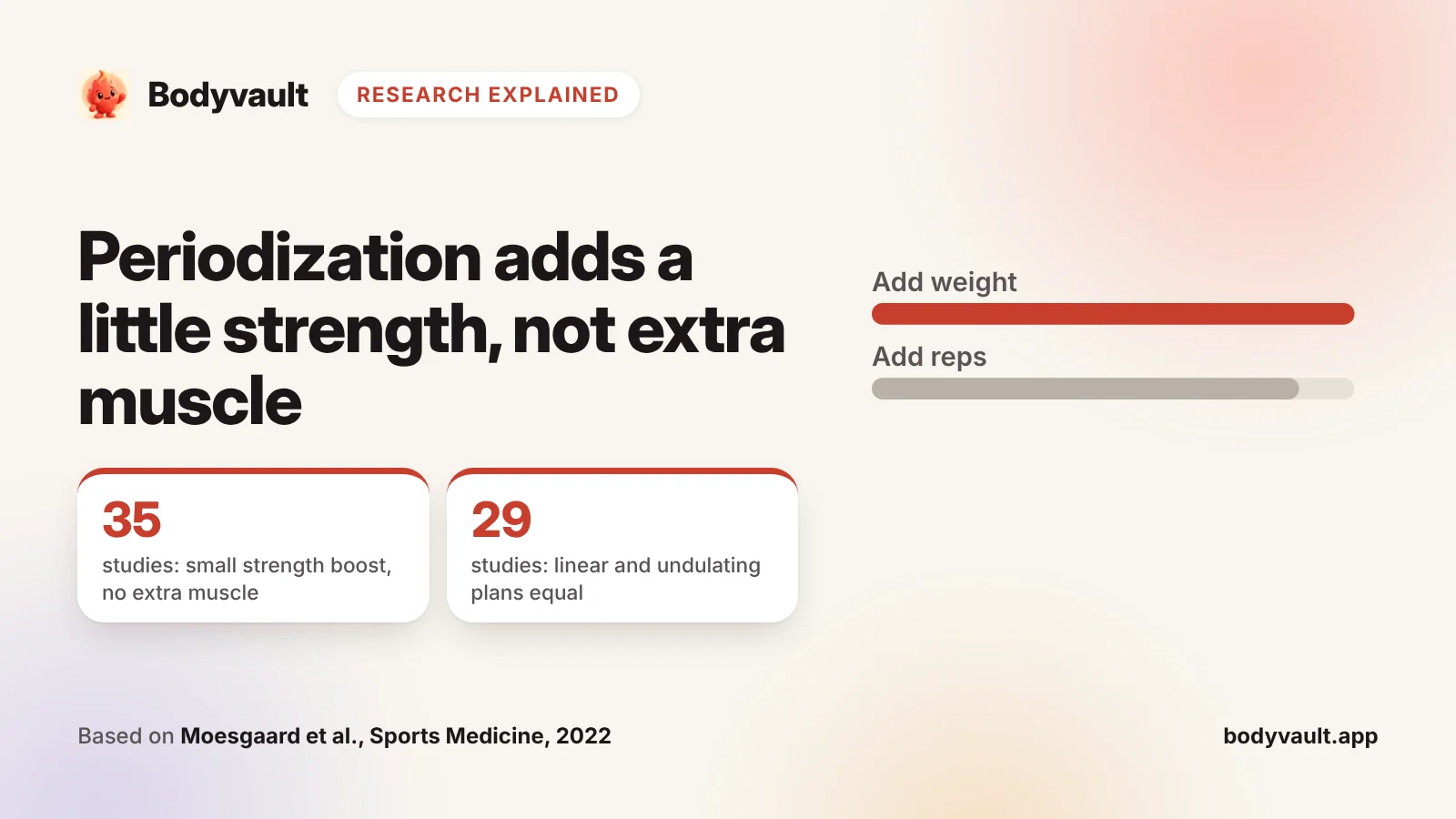
The short answer
35
Studies in a 2022 review. Planned changes gave a small strength boost but no extra muscle
29
Studies in a 2026 review. Linear and undulating plans built strength about equally
≈20kg
Squat gain in 8 weeks, whether lifters added reps or added weight
4–6wk
Usual gap between easier weeks in coaching practice
Strength of evidenceModerate
Several reviews agree that the type of plan makes little difference to muscle growth. For strength, any gain is small and not certain. Research on deload weeks is new: one trial and one expert survey.
Key findingAny sensible plan that slowly asks more of you will work. The style of periodization is a detail. It may help strength a little in experienced lifters, but it doesn’t add muscle.
What is periodization in training?
Periodization means planning changes to your training over weeks or months. You might change how heavy the weights are, how many reps you do or how many sets. The aim is to keep making progress and to manage tiredness.
A plan that stays the same on purpose is called non-periodized. You do the same sets and reps each time and add weight as you get stronger. That is still progress. It just isn’t planned in phases.
The 2026 guideline from the American College of Sports Medicine (ACSM) describes three common styles:
- Linear periodization. The weights get heavier and the reps fewer as the weeks go by.
- Undulating periodization. The reps and weights change from day to day or week to week. Daily undulating periodization (DUP) might mean a heavy day, a medium day and a light day in one week.
- Block periodization. Training is split into blocks of a few weeks, each with one main goal.
| Style | Week 1 | Week 2 | Week 3 | Week 4 |
|---|---|---|---|---|
| Same plan (non-periodized) | 3 × 10 | 3 × 10 | 3 × 10 | 3 × 10 |
| Linear | 3 × 12 | 3 × 10 | 3 × 8 | 3 × 6 |
| Daily undulating | Mon 3 × 5, Wed 3 × 10, Fri 3 × 15 | Same pattern | Same pattern | Same pattern |
| Block | More sets, lighter | More sets, lighter | Fewer sets, heavier | Short peak |
Does periodization beat a plan that stays the same?
A 2022 review tested this. It pooled the results of 35 earlier studies. In every study, both groups did the same total amount of training, so only the plan was different.
Planned changes gave a small extra gain in one-rep max. That is the most weight you can lift once with good form. Muscle growth was the same either way.
Planned changes vs a plan that stays the same: effect sizes
- Strength: planned vs same plan0.31 (0.04 to 0.57)
- Muscle: planned vs same plan0.13 (−0.10 to 0.36)
- Strength: undulating vs linear0.31 (0.02 to 0.61)
- Strength: undulating vs linear, trained lifters0.61 (0.00 to 1.22)
- Strength: undulating vs linear, beginners0.06 (−0.20 to 0.31)
- Muscle: undulating vs linear0.05 (−0.20 to 0.29)
Look at the trained lifters. For them, undulating plans beat linear plans for strength. In beginners, there was no difference. The authors suggest the extra strength may come from the nerves getting better at heavy lifts, not from more muscle.
The 2026 ACSM guideline looked at 137 reviews. It found that periodization didn’t change muscle growth, and that its effect on strength was unclear. The guideline says periodization matters less than experts used to think.
Linear or undulating periodization: which is better?
A newer review from 2026 compared linear and undulating plans head to head. It pooled 29 studies with 704 people aged 14 to 80.
Strength gains were about the same. That held for upper-body pushing in 23 studies and for the squat in 25 studies. It held for beginners and for trained lifters.
Undulating vs linear periodization: effect sizes
- Upper-body pushing strength0.08 (−0.15 to 0.31)
- Squat strength0.08 (−0.10 to 0.26)
- Squat, trained lifters−0.02 (−0.22 to 0.18)
- Squat, beginners0.25 (−0.09 to 0.59)
- Lean (fat-free) mass0.07 (−0.35 to 0.49)
So the two reviews don’t fully agree about trained lifters. The newer one is bigger, and it found no difference. If undulating plans do help experienced lifters, the gain is small.
Block periodization has less research. The National Strength and Conditioning Association (NSCA) describes a 22-week trial in adults in their early 70s. It compared no periodization, block periodization and daily undulating periodization. All three helped, with no differences between them.
Should you add reps or add weight?
Progressive overload means making training a bit harder over time. You can add weight, or keep the same weight and add reps. Our progressive overload guide shows both, step by step. A 2022 trial compared them.
Researchers put 43 trained young adults into two groups by chance. One group added weight while staying at 8 to 12 reps. The other kept the same weight and added reps. Both did 4 sets of 4 leg exercises, twice a week, for 8 weeks.
Muscle grew about the same in both groups. Strength did too. On average, the weight group gained 21.8 kg on the squat and the reps group gained 19.3 kg. That gap was too small to be sure of.
Do you need a deload week?
A deload is a planned easier spell. In 2023, experienced coaches from several countries agreed on a definition. It is a period of lighter training to reduce tiredness, help recovery and get ready for the next block.
The coaches agreed you can deload by doing fewer sets, fewer reps or fewer sessions. A deload can be planned, or taken when you feel worn out. Earlier interviews found that coaches usually deload every 4 to 6 weeks, for about a week. For a sample week, see our deload week guide.
The first trial on deloads came out in 2024. Researchers put 50 trained young adults into two groups by chance, and 39 finished. Both groups did a hard 9-week leg programme. One group took week 5 completely off. The other trained straight through.
Muscle grew the same in both groups. Strength rose a bit less in the group that took a week off. The researchers put the chance that training straight through gave more strength at about 85% for the squat and 92% for the knee test. Many people said they felt sluggish after the break, not refreshed.
Keep two things in mind. The deload here was a full week off, not a lighter week. And almost nobody in the study felt they needed a break. So the trial doesn’t show that a lighter week is bad. It does suggest that a break you don’t need won’t bring extra gains.
Does exercise order matter?
A 2021 review of 11 studies asked whether to do big or small exercises first. Big, multi-joint lifts move several joints, like squats and presses. Small, single-joint lifts move one joint, like curls.
Strength grew most on the exercises that came first in the session. Muscle grew the same either way. The 2026 ACSM guideline agrees. Doing a lift early helped its strength but not muscle growth. So put the lift you most want to improve first.
Claims and evidence
ClaimYou need a periodized plan to build muscle.
EvidenceWhen total work was matched, planned changes didn’t add muscle in a review of 35 studies. The 2026 ACSM guideline found the same.
ClaimUndulating periodization is always better than linear.
EvidenceA 2022 review found a small strength edge for undulating plans, in trained lifters only. A bigger 2026 review of 29 studies found no clear difference.
ClaimYou have to add weight every week to keep progressing.
EvidenceIn an 8-week trial, adding reps built about as much muscle and strength as adding weight. Both groups gained about 20 kg on the squat.
ClaimEveryone needs a deload every four weeks.
EvidenceThere is just one trial. A full week off didn’t help muscle and slowed strength a little. Expert coaches favour lighter weeks, planned or taken when you feel worn out.
What this means for you
What this means for you
- Pick a plan you will stick to. Linear, undulating and block plans all work when they slowly ask more of you.
- To progress, add a rep or add a little weight. Both work.
- If you are new to lifting, a simple plan is enough. Changing your reps from day to day may help strength a little once you have trained for a while.
- Put the lift you most want to get stronger at early in your session.
- Take an easier week when you feel worn out or your lifts stall, mostly by cutting sets. If you have pain, feel ill, or get chest pain or dizziness, stop and see a doctor.
What the research can’t tell you yet
- Long-term results. Most studies lasted weeks or a few months, not years.
- Who was studied. Most people were young adults. The deload trial only included people aged 18 to 40.
- Small trials. The two trials here had about 20 people in each group, so small differences are hard to spot.
- Lighter deloads. The deload trial tested a full week off, not the lighter week most lifters use.
How Bodyvault uses this research
Bodyvault’s programme library includes plans built on linear progression, double progression, daily undulating and block periodization. Generated plans, part of Bodyvault Pro, run in blocks of 4 to 6 weeks. Weekly sets rise by about one per muscle, and the last week is a deload with about 45% fewer sets and easier effort. You can also turn a deload on early. Between sessions, Bodyvault suggests adding a rep until every set reaches the top of your rep range, then the smallest weight step. Its generated sessions put the big multi-joint lifts first.
Share or cite this explainer
Bodyvault (2026). Periodization in training: does the plan matter? https://bodyvault.app/blog/periodization
The charts on this page may be reused with a link back to it. The underlying data belong to the studies cited below.
Questions
What is periodization in training?
Periodization means planning how your training changes over weeks or months, such as the weights, reps and sets. The aim is steady progress and less tiredness. When total work is the same, it doesn’t add muscle, but it may add a little strength.
What is daily undulating periodization?
Daily undulating periodization (DUP) changes the reps and weights from one session to the next. For example, you might have a heavy day, a medium day and a light day each week. In a 2026 review of 29 studies, it built strength about as well as linear plans.
What is linear periodization?
Linear periodization makes the weights heavier and the reps fewer as the weeks go by. It works well. In the newest review, it built strength about as well as undulating plans.
What is block periodization?
Block periodization splits training into blocks of a few weeks, each with one main goal, such as more sets, then heavier weights, then a peak. There is less research on it. In one 22-week trial in adults in their 70s, it worked about as well as other plans.
Does exercise order matter?
For strength, yes: you gain most on the exercises you do first. For muscle growth, no. A 2021 review of 11 studies found the same growth either way.
Sources
- Moesgaard L et al. (2022). Effects of periodization on strength and muscle hypertrophy in volume-equated resistance training programs: a systematic review and meta-analysis. Sports Med 52(7):1647–1666.
- Zhang Z et al. (2026). Comparison of linear and undulating periodization resistance training on athletic capacities and health promotion: a systematic review and meta-analysis. Front Public Health 14:1707627.
- Plotkin D et al. (2022). Progressive overload without progressing load? The effects of load or repetition progression on muscular adaptations. PeerJ 10:e14142.
- Coleman M et al. (2024). Gaining more from doing less? The effects of a one-week deload period during supervised resistance training on muscular adaptations. PeerJ 12:e16777.
- Bell L et al. (2023). Integrating deloading into strength and physique sports training programmes: an international Delphi consensus approach. Sports Med Open 9(1):87.
- Nunes JP et al. (2021). What influence does resistance exercise order have on muscular strength gains and muscle hypertrophy? A systematic review and meta-analysis. Eur J Sport Sci 21(2):149–157.
- Currier BS et al. (2026). American College of Sports Medicine position stand. Resistance training prescription for muscle function, hypertrophy, and physical performance in healthy adults: an overview of reviews. Med Sci Sports Exerc 58(4):851–872.
- Fragala MS et al. (2019). Resistance training for older adults: position statement from the National Strength and Conditioning Association. J Strength Cond Res 33(8):2019–2052.
General information about fitness and nutrition, not medical advice. If you have a health condition, are pregnant or take medication, talk to your doctor before changing your diet or training.