
Research explained
How much fibre do you need each day?
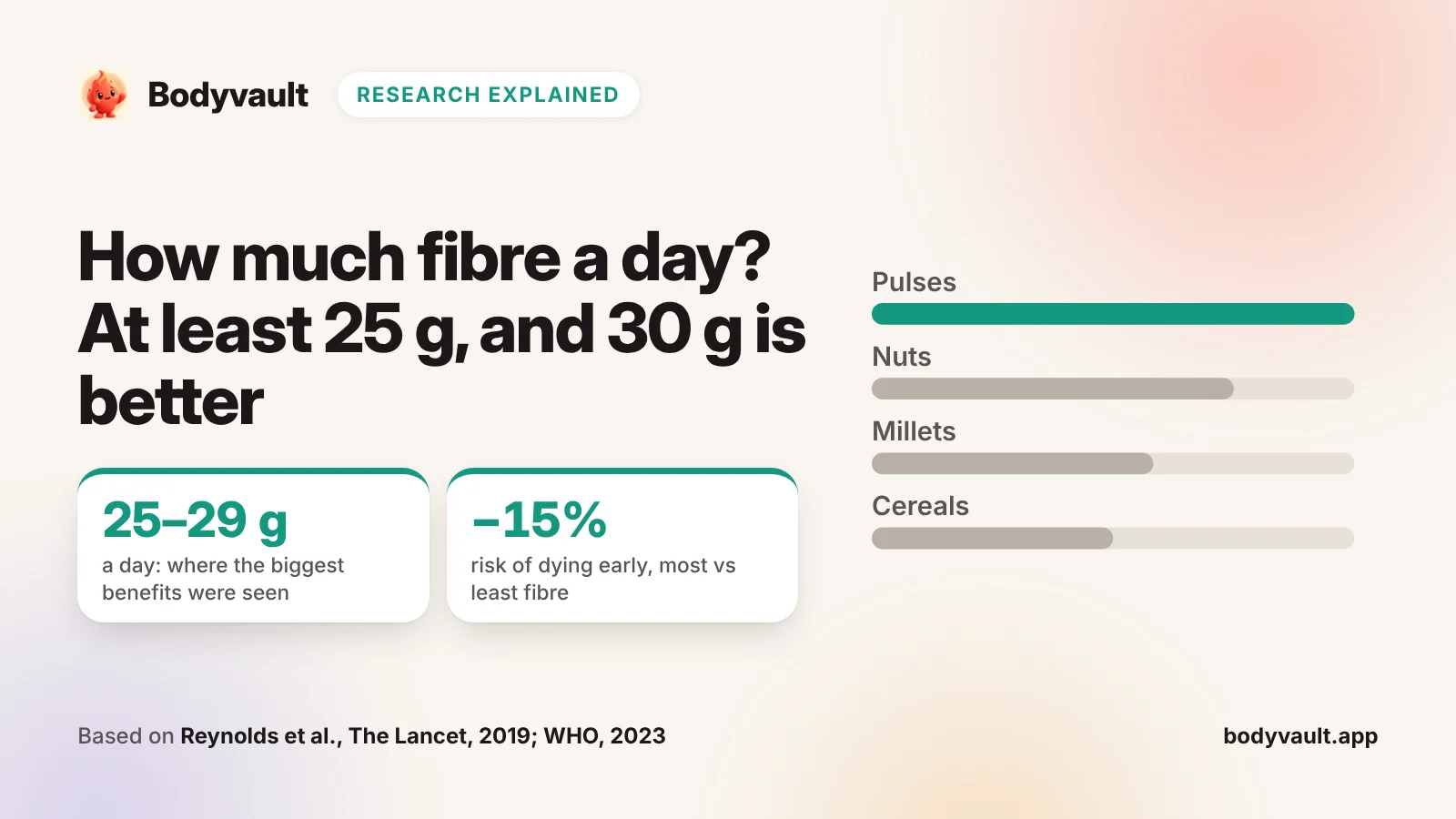
How much fibre do you need each day? Aim for at least 25 g, and about 30 g if you can. In large reviews, people who ate the most fibre had a 15–30% lower risk of heart disease, type 2 diabetes, bowel cancer and early death than people who ate the least. The biggest benefits came at 25–29 g a day.
The short answer
25g
Of fibre a day at least, for adults (World Health Organization, 2023)
25–29g
A day: the range linked with the biggest health benefits, in a review of 185 studies
15–30%
Lower risk of heart disease, type 2 diabetes, bowel cancer and early death in people who ate the most fibre
12–18g
What US adults typically ate a day, in the survey the US experts used
Strength of evidenceGood
Consistent results from 185 studies that followed people over time and 58 trials, rated moderate certainty. The disease results are links. The trials show small drops in weight, blood pressure and cholesterol.
Key findingAim for at least 25 g of fibre a day from food. Pulses, whole grains, millets, vegetables, fruit and nuts are the best sources. Most people eat far less than this.
What is fibre?
Fibre is the part of plant foods your body can’t digest. It is found in whole grains, dal and other pulses, vegetables, fruit, nuts and seeds. Meat, fish, eggs and milk have none. (In the US, it is spelled “fiber”.)
Because you don’t digest it, fibre passes through your gut. Some kinds turn thick and sticky. These slow down how fast food leaves your stomach and help you feel full. They can also lower the rise in blood sugar after a meal, and lower cholesterol. Other kinds add bulk to your stools and ease constipation.
How much fibre each day? What the guidelines say
The World Health Organization (WHO) says adults should eat at least 25 g a day of fibre that comes naturally in food. For children, it suggests at least 15 g at ages 2–5, 21 g at ages 6–9 and 25 g from age 10.
The US and Canadian advice is higher for men: 38 g a day for men and 25 g for women up to age 50. After 50, it is 30 g for men and 21 g for women. These amounts come from a simple rule: 14 g of fibre for every 1,000 calories you eat. On a 2,000-calorie day, that is 28 g (our calculation).
India’s 2024 dietary guidelines don’t give one number for adults. Instead, they advise more fibre-rich foods: whole grains, millets, pulses, nuts and vegetables.
Many people fall well short. In the US survey the experts used, men ate about 16–18 g a day and women about 12–14 g.
What the big review found
This review compared people who ate the most fibre with those who ate the least. Most of its data come from studies that followed large groups of people over time. This kind of study shows a link. It can’t prove that one thing causes the other.
Risk in people who ate the most fibre, compared with the least
- Coronary heart disease−24%
- Death from heart and blood vessel disease−23%
- Stroke−18%
- Type 2 diabetes−16%
- Bowel (colorectal) cancer−16%
- Death from any cause−15%
- Breast cancer−7%
The more fibre, the lower the risk. Each extra 8 g a day went with about a 10–20% lower risk across most outcomes. That 8 g is about what 70 g of raw dal or other pulses gives (our calculation).
WHO looked for harms too. Apart from one link with womb cancer, rated very low certainty, it found no downsides at 25 g a day or more. Few studies looked at more than 40 g a day.
Does fibre help you lose weight?
A little. In 27 trials with 2,495 people, eating more fibre lowered body weight by 0.37 kg on average, compared with eating less. Most trials lasted less than 6 months. They also showed small drops in blood pressure and LDL (“bad”) cholesterol.
So there is no special amount of fibre for weight loss. The US experts found no strong proof that fibre on its own changes fullness or weight. Still, India’s guidelines note that fibre slows digestion and helps you feel full, so fibre-rich meals fit well in a weight-loss plan. To set a calorie target, use the calorie deficit calculator.
Fibre in Indian foods
Of the foods you eat in large amounts, pulses carry the most fibre, then nuts, millets and cereals. Milk, eggs, meat and fish have none. Polishing rice and refining flour into maida removes some fibre.
How much is that in a day? India’s sample day of meals, “My Plate for the Day”, uses 250 g of cereals and millets, 85 g of pulses, 400 g of vegetables, 100 g of fruit and 35 g of nuts and seeds (raw weights, for a vegetarian day of about 2,000 calories). With the averages above, that gives about 38 g of fibre (our calculation), well above the 25 g minimum.
Whole fruit beats juice, because juicing removes the fibrous pulp.
Claims and evidence
ClaimYou only need fibre if you’re constipated.
EvidenceFibre does ease constipation. But people who ate the most fibre also had lower rates of heart disease, type 2 diabetes and bowel cancer.
ClaimFruit juice is as good as whole fruit.
EvidenceIndia’s guidelines say whole fruit is better, because juicing removes the fibrous pulp.
ClaimA fibre supplement does the same job as fibre-rich food.
EvidenceWHO’s advice is for fibre that comes naturally in food. The review behind it left supplement trials out, so the benefits were seen with food.
ClaimMore than 30 g of fibre a day is too much.
EvidenceNo upper limit has been set. The data hinted at extra benefit above 30 g a day, though fewer studies covered that range.
What this means for you
What this means for you
- Aim for at least 25 g of fibre a day, and around 30 g if you can.
- Eat pulses every day: dal, rajma, chana or sprouts.
- Choose whole grains and millets, such as jowar, bajra and ragi, more often than maida or polished white rice.
- Eat whole fruit rather than juice, and have vegetables at most meals. India’s sample day includes 400 g of vegetables.
- Drink enough fluids as you eat more fibre. If you have a bowel condition or have had bowel surgery, ask your doctor or a dietitian before big changes.
What the research can’t tell you yet
- Links, not proof. The disease results come from studies that followed people over time. People who eat more fibre may have other healthy habits too.
- Short trials. Most fibre trials lasted less than 6 months and measured things like weight and cholesterol, not disease.
- Where the studies were done. Most were in Europe and North America, with only a few elsewhere.
- High intakes. Few studies looked at more than 40 g a day.
- Children. WHO’s numbers for children are worked out from adult data.
How Bodyvault uses this research
Bodyvault’s automatic fibre target is 14 g for every 1,000 calories in your calorie target, the same rule as the US advice. On a 2,000-calorie target, that is 28 g. If you log food on at least 3 days and your 7-day average falls below 70% of your target, the Coach suggests easy swaps: whole dals, rajma, chana, vegetables, fruit with the peel and millets.
Share or cite this explainer
Bodyvault (2026). How much fibre do you need each day? https://bodyvault.app/blog/how-much-fiber-per-day
The charts on this page may be reused with a link back to it. The underlying data belong to the studies cited below.
Questions
How much fiber do I need a day?
Adults should aim for at least 25 g of fibre (spelled fiber in the US) a day. US advice is 38 g for men and 25 g for women up to age 50. A simple rule is 14 g for every 1,000 calories you eat.
How much fiber is too much?
No upper limit has been set, because there wasn’t enough evidence of harm. WHO found no downsides at 25 g a day or more, apart from one link rated very low certainty. Few studies looked above 40 g a day.
How much fiber per day to lose weight?
There is no special amount: the same 25–30 g applies. In trials, eating more fibre lowered weight by about 0.4 kg on average, so fibre is a helper, not a weight-loss method on its own.
How much fibre should I eat when pregnant?
US advice is 28 g a day in pregnancy and 29 g when breastfeeding. India’s guidelines suggest fibre-rich foods and enough fluids to help prevent constipation. Ask your doctor about your own needs.
Which Indian foods are high in fibre?
Pulses such as dal, rajma and chana (about 12 g per 100 g raw), nuts (about 9 g), millets such as jowar, bajra and ragi (about 7 g) and cereals (about 6 g on average). Vegetables and fruit have about 2 g per 100 g.
Sources
- Reynolds A et al. (2019). Carbohydrate quality and human health: a series of systematic reviews and meta-analyses. Lancet 393(10170):434–445.
- World Health Organization (2023). Carbohydrate intake for adults and children: WHO guideline. Geneva: WHO.
- Institute of Medicine (2005). Dietary Reference Intakes for Energy, Carbohydrate, Fiber, Fat, Fatty Acids, Cholesterol, Protein, and Amino Acids, chapter 7: Dietary, functional, and total fiber. Washington, DC: The National Academies Press.
- ICMR-NIN (2024). Dietary Guidelines for Indians, revised edition.
General information about fitness and nutrition, not medical advice. If you have a health condition, are pregnant or take medication, talk to your doctor before changing your diet or training.