
Research explained
How many glasses of water a day? The 8-glass rule checked
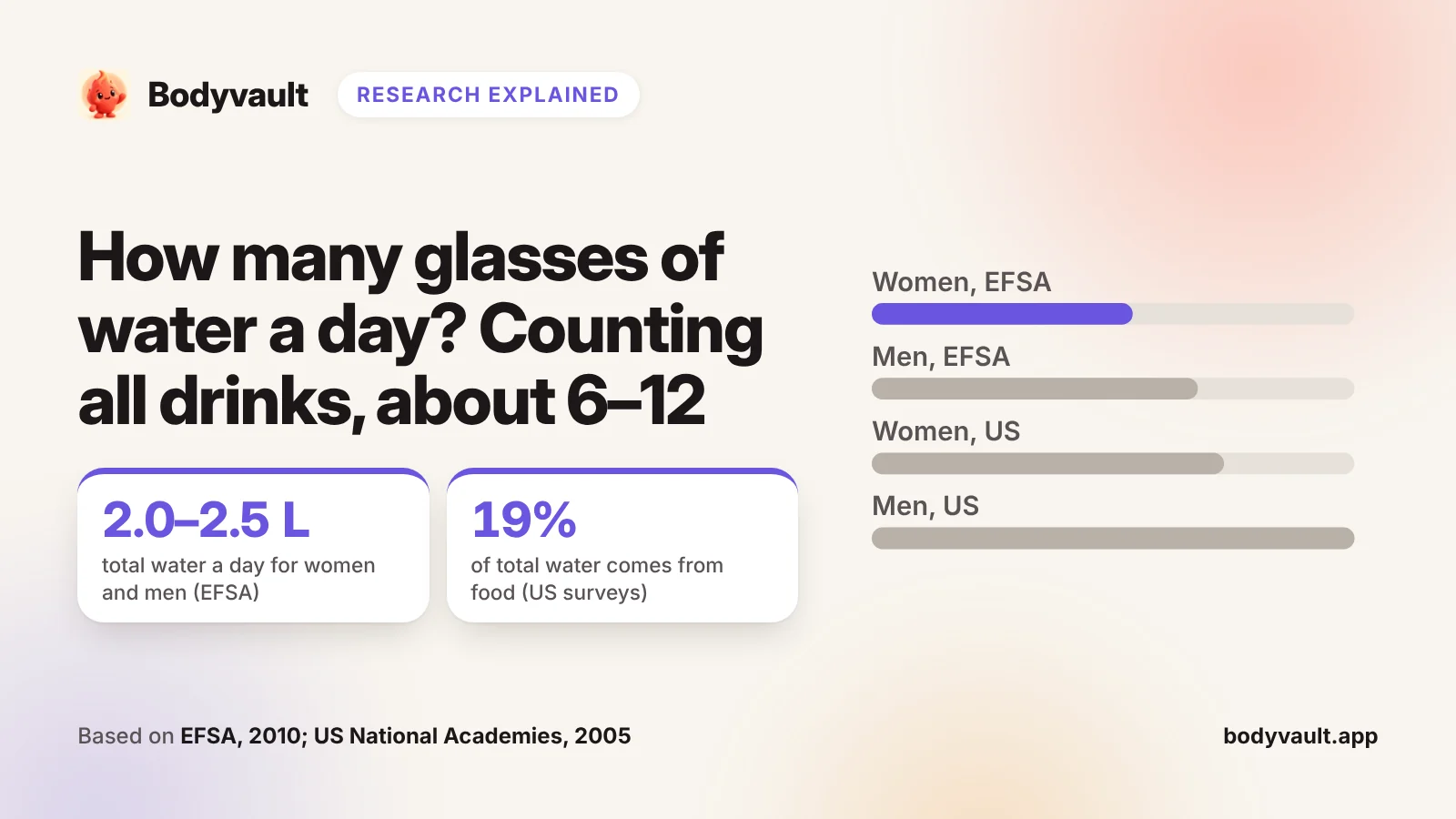
How many glasses of water a day do you need? Official advice works out at about 6–9 glasses a day for women and 8–12 for men (250 ml each), counting all drinks. Food adds about a fifth more water. Eight glasses is a fair middle guess, but no study shows everyone needs exactly that.
The short answer
2.0L
Total water a day for women in Europe’s advice, from drinks and food. For men it is 2.5 L
9–13cups
Cups of drinks a day (8 oz) in the US advice: about 9 for women and 13 for men
19%
Of total water comes from food, in US surveys
0studies
Found to back a strict “at least 8 glasses” rule, in a 2002 review
Strength of evidenceModerate
Official amounts are based on what healthy people usually drink, not on trials of how much is best. Needs vary a lot with body size, activity and heat.
Key findingEight glasses of 250 ml (2 litres) is a reasonable starting point for many adults, and India’s guidelines say the same. But tea, coffee, milk and the water in food all count, and you need more in hot weather or when you sweat.
Where did 8 glasses of water a day come from?
No one has found a study behind it. In 2002, a US physiologist (a scientist who studies how the body works) searched for the source of “drink at least eight 8-oz glasses of water a day”. He also asked experts on thirst and drinking. He found no scientific studies that support it for healthy adults.
Older official advice may be part of the story. In 1989, the US guide said adults need about 1 ml of water for each calorie they burn. For someone burning 2,000 calories, that is 2 litres: eight 250 ml glasses (our calculation). But that figure counted water from all sources, food included. In 2005, the US National Academies wrote that confusion about how much to drink comes partly from misreading earlier advice, such as this 1989 guide.
A 2022 study of water use in 5,604 people agreed. Its authors wrote that the advice to drink eight 8-oz glasses a day “is not backed by objective evidence”.
How many glasses of water a day do official guides suggest?
Europe’s food safety agency (EFSA) and the US National Academies both set an “adequate intake”. That is the amount healthy people usually take in, judged to be enough. Both count all drinks and the water in food. EFSA’s figures assume moderate temperatures and moderate activity.
Food gives about a fifth of this water. In the US advice, drinks make up about 2.2 litres a day for women and 3.0 litres for men. India’s 2024 guidelines say a healthy person needs about eight glasses (about 2 litres) of water and other drinks a day.
What about US glasses? A US 8 oz glass holds about 237 ml. So 8 glasses of 8 oz is 64 oz, or about 1.9 litres (our calculation). The US advice works out at about 9 cups of drinks a day for women and 13 for men.
Your needs can be very different
In 2022, researchers measured how much water 5,604 people used each day. Scientists call this “water turnover”. It differed a lot from person to person.
Heat matters. People used about 1 litre a day more at 30 °C than at 0–10 °C. Athletes used about 1 litre more than non-athletes. In the last three months of pregnancy, water use rose by about 670 ml a day.
Official guides agree that needs rise with heat and activity. India’s guidelines say to drink more in very hot weather and during hard physical work. US estimates for people in hot climates ranged from 4 to 12 litres a day, from inactive to very active.
Do tea, coffee and food count?
Yes. The US National Academies concluded that tea, coffee and other drinks with caffeine add to your daily water much like other drinks do. Milk, buttermilk and lemon water count too. Many fruits and vegetables are 85–95% water. If you drink tea or coffee late in the day, see how long caffeine lasts.
India’s guidelines suggest buttermilk, lemon water, coconut water and fresh juice without added sugar over soft drinks, which they say to avoid. Tender coconut water has about 15 calories per 100 ml. People with kidney or heart disease who are prone to high potassium should avoid it.
Can you drink too much water?
It is rare, but yes. Healthy kidneys can get rid of about 0.7 to 1 litre an hour at most. Drinking much faster than that for hours can dilute the sodium in your blood to a dangerous level. During exercise, this is usually linked with endurance events lasting more than 6 hours. For healthy people in daily life, no upper limit has been set.
Claims and evidence
ClaimEveryone needs exactly 8 glasses of plain water a day.
EvidenceA 2002 review found no studies behind this. Official figures work out at about 6 to 12 glasses of drinks, depending on sex and on which guide you use. Size, activity and heat change needs too.
ClaimTea and coffee don’t count, because they dry you out.
EvidenceThe US National Academies found that drinks with caffeine add to your daily water much like other drinks.
ClaimFood doesn’t count towards your water.
EvidenceAbout a fifth of total water came from food in US surveys. Fruits and vegetables are 85–95% water.
ClaimThe more water you drink, the healthier you are.
EvidenceThe US experts found too little evidence to set water amounts for preventing long-term disease. Drinking far more than your kidneys can clear can be dangerous.
What this means for you
What this means for you
- Use about 8 glasses (2 litres) of drinks a day as a starting point, and let thirst guide you. Men and larger or active people often need more.
- Count all drinks: water, tea, coffee, milk, buttermilk and lemon water. Limit sugary soft drinks.
- Drink more in hot weather, when you sweat, and when pregnant or breastfeeding. The water intake calculator can add your own sweat rate.
- If you’re older, drink regularly even when you don’t feel thirsty, because thirst can weaken with age.
- If you have heart failure or kidney disease, or a doctor has limited your fluids, follow their advice instead.
What the research can’t tell you yet
- Based on habits, not trials. Official amounts reflect what healthy people usually drink. No trial has tested how much water is best.
- Turnover isn’t need. The 2022 study measured water use, not whether people were well hydrated.
- Climate. EFSA’s figures assume moderate temperatures and activity. Hot weather raises needs.
- Long-term health. There is too little evidence to set water amounts that prevent long-term disease.
How Bodyvault uses this research
You can log water with one tap: a 250 ml glass on Apple Watch, or a Control Center button on iPhone that you can set from 50 to 1,000 ml. You can set your own daily target, from 1 to 6 litres. If you turn on nudges, Bodyvault checks at 11 a.m., 2 p.m. and 5 p.m. and reminds you only if you’re more than 500 ml behind an even pace for your day. To pick a target, try the water intake calculator.
Share or cite this explainer
Bodyvault (2026). How many glasses of water a day? The 8-glass rule checked. https://bodyvault.app/blog/how-many-glasses-of-water-a-day
The charts on this page may be reused with a link back to it. The underlying data belong to the studies cited below.
Questions
How many glasses of water a day should I drink?
About 8 glasses of 250 ml from all drinks is a good starting point for many adults. Official advice works out at about 6–9 glasses for women and 8–12 for men, plus water from food. Drink more in heat or when you sweat.
How many ounces is 8 glasses of water a day?
Eight 8-oz glasses is 64 fl oz, or about 1.9 litres. The US advice works out at about 74 oz of drinks a day for women and 101 oz for men.
Is 8 glasses of water a day enough?
For many women and smaller adults in a mild climate, it is about right. Men, active people and anyone in hot weather may need more. Thirst is a good everyday guide for healthy adults.
Is 8 glasses of water a day a myth?
Partly. No study shows that everyone needs exactly 8 glasses of plain water. But 2 litres from all drinks is close to official advice for many adults, and India’s guidelines suggest about 8 glasses including other drinks.
Do I need more water when pregnant?
Yes, a little. Europe’s advice adds 300 ml a day in pregnancy and about 700 ml when breastfeeding. India’s guidelines suggest more than 2 litres of fluids a day. Ask your doctor or midwife about your own needs.
Sources
- EFSA Panel on Dietetic Products, Nutrition and Allergies (2010). Scientific opinion on dietary reference values for water. EFSA J 8(3):1459.
- Institute of Medicine (2005). Dietary Reference Intakes for Water, Potassium, Sodium, Chloride, and Sulfate. Washington, DC: The National Academies Press.
- ICMR-NIN (2024). Dietary Guidelines for Indians, revised edition.
- Yamada Y et al. (2022). Variation in human water turnover associated with environmental and lifestyle factors. Science 378(6622):909–915.
- Valtin H (2002). “Drink at least eight glasses of water a day.” Really? Is there scientific evidence for “8 × 8”? Am J Physiol Regul Integr Comp Physiol 283(5):R993–R1004.
- National Research Council (1989). Recommended Dietary Allowances, 10th edition, chapter 11: Water and electrolytes. Washington, DC: National Academy Press.
General information about fitness and nutrition, not medical advice. If you have a health condition, are pregnant or take medication, talk to your doctor before changing your diet or training.