
Research explained
Mifflin-St Jeor formula: how accurate is your BMR?
The Mifflin-St Jeor formula is the most accurate of the common ways to estimate your BMR, the calories you burn at rest. In tests, it landed within 10% for about 8 in 10 adults. So it is a good first guess, not an exact answer.
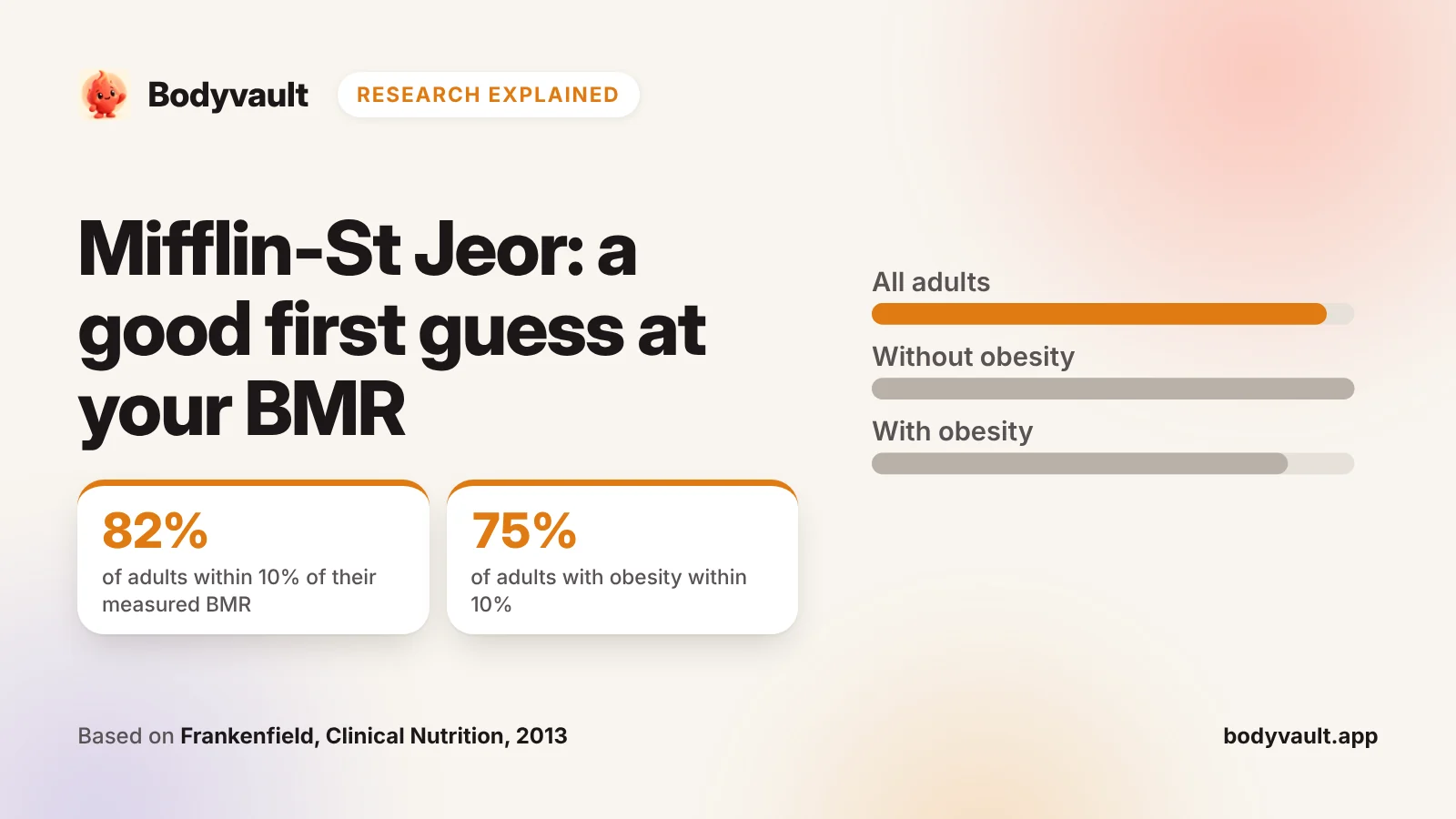
The short answer
82%
Of 337 adults got an estimate within 10% of their measured resting energy
75%
Within 10% for people with obesity, compared with 87% for people without
498
Adults whose resting energy was measured to build the formula in 1990
1.4–2.4
Activity factors to multiply your BMR by, from mostly sitting to very active
Strength of evidenceGood
Several studies have tested the formula against measured resting energy, and a careful review ranked it first of the common formulas. But most people tested were in the US, and few were older adults.
Key findingMifflin-St Jeor is the best everyday starting point. Still, it misses by more than 10% for about 1 in 5 people. So use it to start, then adjust from what your weight actually does.
What is the Mifflin-St Jeor formula?
Your basal metabolic rate, or BMR, is the energy (calories) your body burns just to keep you alive at rest. It powers your heart, lungs, brain and other organs. For adults, it is about 45–70% of all the calories you burn in a day.
The Mifflin-St Jeor formula estimates your BMR from four things: your weight, height, age and sex. A team led by Mifflin and St Jeor published it in 1990. Dietitians use it often, and so do many calorie calculators.
- Men: 10 × weight in kg + 6.25 × height in cm − 5 × age in years + 5
- Women: 10 × weight in kg + 6.25 × height in cm − 5 × age in years − 161
The answer is in kilocalories (kcal) a day, the “calories” on food labels. For the same weight, height and age, the men’s formula gives 166 kcal a day more.
The researchers measured each person once. Fat-free mass, meaning everything in your body that isn’t fat, was the best single predictor of resting energy. But weight, height, age and sex together did even better, and they are much easier to know.
A worked example
Here is the formula for a woman aged 32 who weighs 68 kg and is 162 cm tall. This is our own calculation, and it matches the example in our calorie deficit calculator.
| Step | Sum | Result |
|---|---|---|
| Weight | 10 × 68 | 680 |
| Height | 6.25 × 162 | +1,012.5 |
| Age | 5 × 32 | −160 |
| Women’s number | fixed | −161 |
| BMR | 680 + 1,012.5 − 160 − 161 | 1,371.5 kcal a day |
So her BMR is about 1,370 kcal a day. Now take a man aged 40 who weighs 80 kg and is 178 cm tall. His sum is 800 + 1,112.5 − 200 + 5, or about 1,720 kcal a day.
Is the Mifflin-St Jeor equation accurate?
For most people, it is close. A 2005 review for dietitians compared the four most used formulas. It was a systematic review: a careful review of all the studies on one question. Mifflin-St Jeor came within 10% of measured resting energy in more people than any other formula. Its errors also had the narrowest range.
A 2013 study gives the numbers. A researcher in the US measured the resting energy of 337 adults and compared it with seven formulas. Mifflin-St Jeor was right on average, while most of the others guessed too high. It landed within 10% for 82% of people.
That leaves about 1 in 5 people who are more than 10% off. For the woman above, 10% either way means a true BMR anywhere from about 1,230 to 1,510 kcal a day (our calculation). The formula can’t tell which end she is at.
It also worked less well for some groups. Accuracy was lower in people with obesity, whatever formula was used. The 2005 review also warned that the studies included too few older adults and people from ethnic minorities in the US. For those groups, treat any formula with extra care.
Mifflin-St Jeor vs Harris-Benedict
The Harris-Benedict formula dates from 1919 and is still common. In the 1990 study, it overestimated measured resting energy by 5% on average. In the 2013 study, it was one of the formulas that tended to guess too high, while Mifflin-St Jeor did not. So for most adults, Mifflin-St Jeor is the better choice.
Mifflin-St Jeor vs Katch-McArdle and other lean-mass formulas
Some formulas use your lean mass instead: your weight minus your body fat. In 1980, a researcher called Cunningham looked again at the 1919 data from 223 people. Lean mass alone predicted BMR well, and sex and age added little. His formula is 500 + 22 × lean mass in kg. Whether metabolism really slows with age is in does metabolism slow with age.
The Katch-McArdle formula, which many apps use, also starts from lean mass. This post uses Cunningham’s, because we could check it in its original journal paper.
Lean-mass formulas need a good body-fat number. If your body-fat figure is off, the answer moves with it. For our example woman, Cunningham’s formula gives 1,622 kcal at 25% body fat but 1,472 kcal at 35% (our calculation). That is a 150 kcal swing from the body-fat number alone.
Activity factors for Mifflin-St Jeor
Your BMR is only the energy you burn at rest. To estimate all the calories you burn in a day, your TDEE or maintenance calories, you multiply your BMR by an activity factor. Experts call it your physical activity level, or PAL.
The standard ranges come from a 2004 expert report. Three bodies wrote it together: the Food and Agriculture Organization (FAO), the World Health Organization (WHO) and the United Nations University (UNU). It is advice written by a panel of experts after reviewing the research.
| Lifestyle | Activity factor (PAL) | Examples from the report |
|---|---|---|
| Sedentary or light activity | 1.40–1.69 | Office work, travel by car or bus, no regular exercise, free time spent mostly sitting |
| Active or moderately active | 1.70–1.99 | A desk job plus about an hour of jogging, cycling or sport a day, or building work |
| Vigorous or vigorously active | 2.00–2.40 | Hours of hard work or sport each day, such as farm work by hand or two hours of swimming |
The report says levels above 2.40 are hard to keep up for long. One hour a day of jogging, cycling or sport can lift a desk worker from about 1.55 to 1.75. In a review of 411 adults with mostly desk-based Western lifestyles, a typical level was about 1.60.
So choosing your activity level matters more than choosing a BMR formula. If you can’t decide between two levels, try the lower one for a few weeks and see what your weight does.
What about Indian adults?
India’s National Institute of Nutrition (ICMR-NIN) looked at this in 2020. It compared the FAO/WHO/UNU formulas with BMR measured in Indian adults. The formulas can overestimate Indian BMR by 10–12%, because their data included many young, muscular people. Indians tend to carry relatively more body fat.
So ICMR-NIN now takes about 10% off the FAO/WHO/UNU result for Indian adults, in two cuts of 5%. It also lowered the activity factor for sedentary people from 1.53 to 1.40, because Indian studies found that daily tasks used less energy.
This change was made for the FAO/WHO/UNU formulas, not for Mifflin-St Jeor. No study in our library has tested Mifflin-St Jeor in Indian adults. If you are of Indian origin, your real needs may be a little lower than any formula suggests. Your weight trend over a few weeks will show you.
Claims and evidence
ClaimA BMR calculator tells you exactly how many calories you burn.
EvidenceIt gives an estimate. Mifflin-St Jeor landed within 10% for 82% of adults tested, so about 1 in 5 people were further off than that.
ClaimHarris-Benedict and Mifflin-St Jeor are equally good.
EvidenceIn the 1990 study, Harris-Benedict overestimated measured resting energy by 5%. Reviews in 2005 and 2013 ranked Mifflin-St Jeor first of the common formulas.
ClaimA lean-mass formula is always more accurate.
EvidenceLean mass predicts BMR well, but only if your body-fat number is right. For our example woman, a 10-point change in body fat moved Cunningham’s answer by 150 kcal a day.
ClaimVery active people should multiply their BMR by 2.5 or more.
EvidenceThe FAO/WHO/UNU report says activity levels above 2.40 are hard to keep up for long. Levels that high are seen in extreme cases, such as three weeks of bike racing.
What this means for you
What this means for you
- Use Mifflin-St Jeor as your starting estimate. The calorie deficit calculator does the sums for you.
- Take more care over your activity level than over the formula. It changes the answer far more.
- Treat the result as a first guess. Keep your eating steady for a few weeks, weigh yourself often, and adjust if your weight moves in a way you didn’t expect.
- If you know your body fat from a reliable test, a lean-mass formula gives a useful second opinion. A rough guess doesn’t, because any error in your body fat carries straight into the answer.
- These formulas are for adults who aren’t pregnant or breastfeeding. If you have a health condition or an eating disorder, ask a doctor or dietitian for advice.
What the research can’t tell you yet
- Your own number. Every formula gives an average for people like you. Only a lab test of your breathing at rest measures your BMR directly.
- Who was studied. The formula and its main tests come from US adults. They included too few older adults and people from ethnic minorities, and we found no test in Indian adults.
- Newer data. The main review is from 2005, and the 2013 study tested one group of 337 adults.
- Real life. Activity factors describe a whole lifestyle. They can’t follow a week that is busier or quieter than usual.
How Bodyvault uses this research
Bodyvault starts your calorie target with the Mifflin-St Jeor formula. If you add a body-fat reading, it switches to a lean-mass formula (Katch-McArdle), and the targets screen shows which one it used. With Bodyvault Pro, the adaptive mode then blends that first guess with what your weigh-ins and logged food show over four weeks. That way, your target follows your real body rather than the formula.
Share or cite this explainer
Bodyvault (2026). Mifflin-St Jeor formula: how accurate is your BMR? https://bodyvault.app/blog/mifflin-st-jeor-formula
The charts on this page may be reused with a link back to it. The underlying data belong to the studies cited below.
Questions
What is the Mifflin-St Jeor equation?
It is a formula that estimates your BMR, the calories you burn at rest, from your weight, height, age and sex. For men: 10 × kg + 6.25 × cm − 5 × age + 5. For women, the last number is −161 instead of +5.
Is the Mifflin-St Jeor equation accurate?
It is the most accurate of the common formulas. In a study of 337 adults, it came within 10% of measured resting energy for 82% of people, and for 75% of people with obesity. So treat it as a good first guess.
Mifflin-St Jeor or Harris-Benedict: which is better?
Mifflin-St Jeor. The older Harris-Benedict formula overestimated measured resting energy by 5% in the 1990 study, and later reviews ranked Mifflin-St Jeor first.
Mifflin-St Jeor vs Katch-McArdle: which should I use?
If you don’t know your body fat well, use Mifflin-St Jeor. Lean-mass formulas such as Katch-McArdle and Cunningham can work well, but only with a body-fat number from a reliable test.
What activity factor should I use with Mifflin-St Jeor?
Use the FAO/WHO/UNU ranges. Pick 1.40–1.69 if you mostly sit, and 1.70–1.99 if you are active. Pick 2.00–2.40 only if you do hours of hard work or sport each day. Multiply your BMR by the factor to get your daily calories.
Sources
- Mifflin MD, St Jeor ST, Hill LA, et al. (1990). A new predictive equation for resting energy expenditure in healthy individuals. Am J Clin Nutr 51(2):241–247.
- Frankenfield D, Roth-Yousey L, Compher C (2005). Comparison of predictive equations for resting metabolic rate in healthy nonobese and obese adults: a systematic review. J Am Diet Assoc 105(5):775–789.
- Frankenfield DC (2013). Bias and accuracy of resting metabolic rate equations in non-obese and obese adults. Clin Nutr 32(6):976–982.
- Cunningham JJ (1980). A reanalysis of the factors influencing basal metabolic rate in normal adults. Am J Clin Nutr 33(11):2372–2374.
- FAO, WHO, UNU (2004). Human energy requirements: report of a joint FAO/WHO/UNU expert consultation, Rome, 17–24 October 2001. FAO Food and Nutrition Technical Report Series 1.
- ICMR-National Institute of Nutrition (2020). A brief note on nutrient requirements for Indians: recommended dietary allowances and estimated average requirements 2020. Hyderabad: ICMR-NIN.
General information about fitness and nutrition, not medical advice. If you have a health condition, are pregnant or take medication, talk to your doctor before changing your diet or training.